Physics · Ch 6 — System of Particles and Rotational Motion
Dynamics of Rotational Motion About a Fixed Axis
Dynamics of Rotational Motion About a Fixed Axis
Opening the Dynamics of Rotational Motion
The previous sections built the language of rotational motion — angular displacement, velocity, acceleration, moment of inertia, and torque. Now we put these tools to work. The central question: What happens when a torque acts on a rigid body rotating about a fixed axis? The answer mirrors Newton's second law for linear motion, but with rotational analogues: torque replaces force, moment of inertia replaces mass, and angular acceleration replaces linear acceleration.
But there is a subtlety. In linear motion, force and acceleration are always in the same direction. In rotation, torque and angular acceleration are related by the moment of inertia, which depends on how mass is distributed. The dynamics are richer, and we must account for the work done by torques, the power delivered, and the energy stored in the rotating body.
The Rotational Analogue of Newton's Second Law
Consider a rigid body rotating about a fixed axis. Take a small mass element at a perpendicular distance from the axis. When a net external torque acts on the body, each mass element experiences a tangential force. For the -th element, Newton's second law in the tangential direction gives:
where is the angular acceleration (same for all particles in a rigid body). The torque on this element about the axis is:
Summing over all particles:
The left side is the net external torque (internal torques cancel in pairs by Newton's third law). The sum in parentheses is the moment of inertia about the fixed axis. Thus:
This is the rotational analogue of . It holds only when the axis is fixed and the moment of inertia is constant.
This equation is not a vector equation in the same sense as . Torque and angular acceleration are both vectors along the axis of rotation, but the relation is a scalar equation for the components along the fixed axis. The full vector form works only when is a scalar — which is true for rotation about a fixed axis of symmetry.
Work Done by a Torque
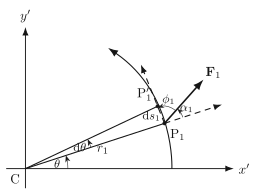
When a torque rotates a body through an angular displacement, it does work. Consider a force acting at a point on a rotating body. The force has a tangential component that does work, and a radial component that does no work (it points toward the axis).
For a small angular displacement , the point of application moves a distance along the arc. The work done by the tangential force is:
But is the torque about the axis. Therefore:
For a finite angular displacement from to :
If the torque is constant, this simplifies to .
This is the exact rotational analogue of linear work: . The torque plays the role of force, and angular displacement plays the role of linear displacement.
Kinetic Energy of Rotation
A rotating rigid body stores kinetic energy. Each mass element moves with speed , so its kinetic energy is . Summing over all particles:
This is the rotational kinetic energy. It is the exact analogue of for linear motion.
The Work-Energy Theorem for Rotation
The work-energy theorem states that the net work done on a body equals the change in its kinetic energy. For rotation, we can derive this directly. Starting from :
Integrating from initial angular speed to final :
Thus:
The work done by the net external torque equals the change in rotational kinetic energy. This is the rotational work-energy theorem.
Power Delivered by a Torque
Power is the rate at which work is done. From :
This is the rotational analogue of for linear motion.
Conservation of Mechanical Energy in Rotational Motion
When only conservative forces (like gravity) do work, mechanical energy is conserved. For a rotating body, the total mechanical energy includes both rotational kinetic energy and potential energy:
where is the height of the centre of mass above a reference level. …
Drawn by us to help you understand the concept clearly, and verified to make sure it's accurate. For exams, practice from your NCERT textbook's own diagram.
The figure shows a single rigid body rotating about a fixed axis that passes through point C. The plane of the drawing is the y′-x′ plane, which is perpendicular to the axis of rotation. The axis itself comes out of the page at C.
A particle of the body, labelled P₁, lies on a circular arc of radius r₁ centred at C. The particle’s angular position is measured by the angle θ that the radius CP₁ makes with some reference line (usually the x′-axis). The particle moves along the arc to a nearby point P₁′. The arc length from P₁ to P₁′ is ds₁, and the corresponding angular displacement is dθ. Because the motion is pure rotation, every particle moves on a circle centred on the axis, and the arc length is related to the angular displacement by ds₁ = r₁ dθ.
At the instant shown, a force F₁ acts on the particle. The force vector is drawn at P₁. Its direction is specified by two angles: it makes an angle φ with the tangent to the circle at P₁, and an angle α with the radius CP₁. The tangent at P₁ is perpendicular to the radius, so φ and α are complementary: φ + α = 90°. The component of F₁ along the tangent is F₁ cos φ = F₁ sin α; this is the component that does work as the particle moves along the arc. The radial component (along CP₁) does no work because it is perpendicular to the displacement ds₁.
The physical idea the figure teaches is this: for a rigid body rotating about a fixed axis, the work done by a force on a particle is the product of the tangential component of the force and the arc length. Since ds₁ = r₁ dθ, the work done by F₁ on particle P₁ is
The product is the torque of the force about the axis (the moment arm is ). So the work done by the force equals the torque times the angular displacement:
This is the key result the textbook develops with this figure. For the entire body, the total work done by all external forces is the sum of the torques about the axis times dθ, which leads directly to the rotational work-energy theorem.
where is the torque about the axis and is the angular displacement. …