Physics · Ch 5 — Work, Energy and Power
Collisions
Collisions
Collisions
In physics, we study motion — change in position. But at the same time, we try to discover physical quantities that do not change during a physical process. The laws of conservation of momentum and conservation of energy are the most powerful examples of such unchanging quantities. In this section, we apply these conservation laws to a very common phenomenon: collisions.
Games like billiards, marbles, and carrom are full of collisions. We will study the collision of two masses in an idealised form. Consider two masses and . The particle is moving with an initial speed (the subscript stands for "initial"). We can take to be at rest without any loss of generality — any collision where both masses are moving can be turned into this situation by shifting to the centre-of-mass frame. So the mass collides with the stationary mass . …
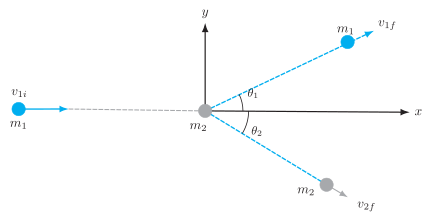
Drawn by us to help you understand the concept clearly, and verified to make sure it's accurate. For exams, practice from your NCERT textbook's own diagram.
The figure is a two-panel sketch on an – coordinate grid. The origin marks the point of collision. Before the collision, a blue sphere of mass moves horizontally from the left along the -axis with velocity . A grey sphere of mass sits stationary at the origin. After the collision, the blue sphere moves up and to the right at an angle above the -axis, with final velocity . The grey sphere moves down and to the right at an angle below the -axis, with final velocity . The arrows representing and are drawn from the origin, showing the two outgoing paths.
The physical idea is a two-dimensional elastic collision between a moving projectile and a stationary target. The figure makes clear that the motion is confined to a plane — the incoming momentum is entirely along , but after the collision the momentum is shared between both bodies in both and directions. The angles and are measured from the original line of motion (the -axis), and they are not independent: conservation of momentum in the -direction forces a relation between them.
The textbook develops the two fundamental conservation laws from this figure. For an elastic collision, kinetic energy is also conserved. The key equations are:
The first equation is conservation of momentum along the -axis: the initial momentum equals the sum of the -components of the final momenta. The second equation is conservation of momentum along the -axis: the initial -momentum is zero, so the upward -component of 's final momentum must equal the downward -component of 's final momentum (the minus sign accounts for opposite directions). The third equation is conservation of kinetic energy, which holds only for an elastic collision.
The angles and are not arbitrary. For a given , , and , these three equations determine the four unknowns , , , and only if one additional condition is given — for example, the impact parameter or the fact that the collision is elastic. In many textbook problems, one of the angles or final speeds is provided. …