Physics · Ch 5 — Work, Energy and Power
The Potential Energy of a Spring
The Potential Energy of a Spring
The Concept of Potential Energy in a Spring
When you stretch or compress a spring, you do work against the restoring force that the spring exerts. That work does not disappear — it gets stored in the spring as elastic potential energy. This is the energy a spring possesses by virtue of being deformed from its natural (unstretched) length.
The key idea is that the spring force is a conservative force, just like gravity. For any conservative force, the work done against it can be recovered as kinetic energy when the system is released. For a spring, the stored energy depends only on how much it is stretched or compressed — not on the path taken to reach that deformation.
The Spring Force and Hooke's Law
Consider an ideal spring that obeys Hooke's law. If one end of the spring is fixed and the other end is attached to a block, the force exerted by the spring on the block when the spring is stretched or compressed by a displacement from its natural length is:
Here is the spring constant (or force constant) — a measure of the spring's stiffness. The negative sign indicates that the spring force always opposes the displacement: if you pull the block to the right (), the spring pulls it back to the left (); if you compress the spring (), the spring pushes outward ().
The variable in Hooke's law is measured from the natural (unstretched) length of the spring, not from any arbitrary reference point. This is crucial for getting the signs and the energy expressions correct.
Work Done by an External Agent
To stretch or compress the spring slowly (so that kinetic energy is negligible), you must apply an external force that exactly balances the spring force at every instant. That means:
The external force is in the same direction as the displacement — you push or pull in the direction you want the spring to move.
The work done by this external force when the spring is stretched from to some final displacement is:
This work is stored as potential energy in the spring. So the elastic potential energy of a spring stretched or compressed by an amount from its natural length is:
Notice that the potential energy depends on , so it is the same whether the spring is stretched () or compressed () by the same amount. A spring compressed by 5 cm stores exactly as much energy as one stretched by 5 cm.
Work Done by the Spring Force
What about the work done by the spring itself? When the spring goes from displacement to , the spring force does work:
This can be written as:
This is exactly the relationship we expect for a conservative force: the work done by the force equals the negative of the change in potential energy.
If the spring starts at and ends at , then . The spring does negative work when being stretched — it is absorbing energy, not releasing it. When the spring is released and returns to its natural length, it does positive work, converting stored potential energy into kinetic energy.
Properties of Spring Potential Energy
The textbook lists three important properties of the spring's potential energy. Each one follows directly from the expression and the nature of the spring force.
Property 1: The potential energy is always positive
Since and , the quantity is never negative. The potential energy is zero only at (the natural length) and positive for any non-zero displacement, whether stretch or compression.
This makes physical sense: you always have to do positive work to deform a spring away from its natural length, and that work is stored as energy. There is no way to get "negative stored energy" from a spring.
Property 2: The force is the negative gradient of potential energy
For a conservative force in one dimension, the force is related to the potential energy by:
Let's verify this for the spring:
This is exactly Hooke's law. The relationship holds perfectly, confirming that the spring force is conservative and that is indeed the correct potential energy function.
This derivative relationship is a powerful tool. If you ever forget the formula for spring potential energy, you can derive it by integrating Hooke's law: , and set by choosing at .
Property 3: The potential energy is quadratic in displacement
The graph of versus is a parabola opening upward, with its vertex at . This quadratic shape has important consequences:
- The minimum of the potential energy is at , which is the stable equilibrium position. If you displace the spring slightly, the restoring force pulls it back toward this point.
- The potential energy increases symmetrically on both sides of the equilibrium. The rate of increase is determined by — a stiffer spring (larger ) gives a steeper parabola and more energy for the same displacement.
- For small displacements, any smooth potential energy curve can be approximated by a parabola (this is the basis of the harmonic oscillator approximation in physics).
--- …
Drawn by us to help you understand the concept clearly, and verified to make sure it's accurate. For exams, practice from your NCERT textbook's own diagram.
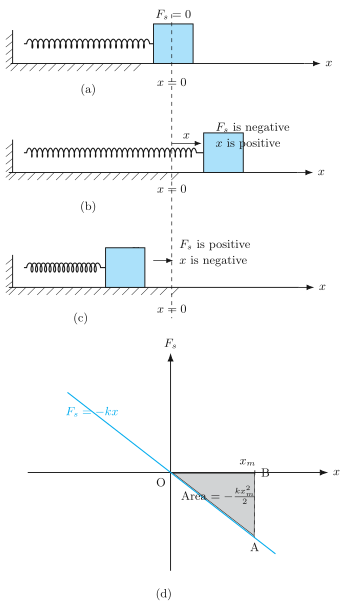
Figure 5.7 is built around a single physical idea: an ideal spring exerts a restoring force that always tries to bring the block back to the equilibrium position. The four panels work together to show what that means visually, algebraically, and graphically.
Panels (a), (b), and (c) show the actual setup. A spring is attached to a rigid wall on the left, with a block on the right. In (a), the block sits at the equilibrium position — the spring is neither stretched nor compressed, so the displacement and the spring force . In (b), the block has been pulled to the right, so (positive displacement). The spring is stretched, and it pulls the block back to the left: the force is negative, . In (c), the block is pushed to the left, so (negative displacement). The spring is compressed, and it pushes the block back to the right: the force is positive, .
The key pattern is that the force always points opposite to the displacement. That is the physical meaning of a restoring force.
Panel (d) translates that pattern into a graph. The horizontal axis is the displacement ; the vertical axis is the spring force . The graph is a straight line through the origin with a negative slope. The line is labelled , where is the spring constant (a measure of the spring's stiffness). The graph shows that when is positive, is negative; when is negative, is positive; and when , . A dashed vertical line is drawn at , marking the maximum stretch shown in the figure. The shaded triangle between the origin O, the point B on the -axis at , and the point A on the force line directly above B represents the work done by the spring as it returns from to .
The work done by the spring force as the block moves from to is the area of that shaded triangle. Because the force is not constant, you cannot use directly — you must integrate, or equivalently, find the area under the vs graph.
The area of the triangle is . The base is (from to ), and the height is the magnitude of the force at , which is . So the work done by the spring is
The negative sign appears because the spring force opposes the displacement — the work done by the spring is negative when the block is being stretched. If instead the spring does work on the block as it returns to equilibrium, that work is positive and equals .
This is the general formula for the work done by an ideal spring when the block moves from an initial displacement to a final displacement . The symbols are:
- : work done by the spring force
- : spring constant (units N/m)
- : initial displacement from equilibrium
- : final displacement from equilibrium
The textbook uses this figure to lead directly into the definition of potential energy of a spring. Since the work done by the spring depends only on the initial and final positions (not on the path taken), the spring force is conservative. That allows us to define a potential energy function such that the change in potential energy equals the negative of the work done by the spring:
…
Drawn by us to help you understand the concept clearly, and verified to make sure it's accurate. For exams, practice from your NCERT textbook's own diagram.
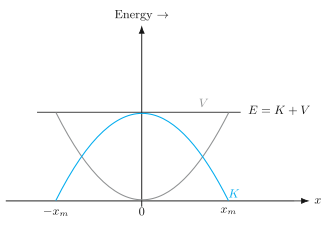
The figure plots two curves against the horizontal position of the block. The vertical axis is energy (in joules), and the horizontal axis is the displacement from the spring’s natural length. The origin is the equilibrium position where the spring is neither stretched nor compressed.
The potential energy of the spring is an upward-opening parabola, . It has its minimum value of zero at and rises symmetrically on both sides. At the extreme points and , the potential energy reaches its maximum value, which equals the total mechanical energy of the system.
The kinetic energy is a downward-opening parabola. At , is at its maximum — equal to — because the block moves fastest through equilibrium. At , drops to zero: the block has momentarily stopped, all its energy stored as spring potential.
A horizontal line at height runs across the plot, representing the constant total mechanical energy. At every , the sum of the and curves equals this line: . The two parabolas are therefore complementary — one rises exactly as the other falls.
Here is the spring constant (stiffness), is the block’s mass, is its speed, and is the displacement from equilibrium. The figure makes this conservation law visual: the vertical gap between the parabola and the line at any is exactly .
The physical idea is that energy sloshes back and forth between kinetic and potential forms as the block oscillates. At the turning points (), energy is all potential; at the centre (), it is all kinetic. The parabolic shapes arise directly from Hooke’s law — the force is linear, so the work done against it (which becomes potential energy) grows quadratically with distance. …
Drawn by us to help you understand the concept clearly, and verified to make sure it's accurate. For exams, practice from your NCERT textbook's own diagram.
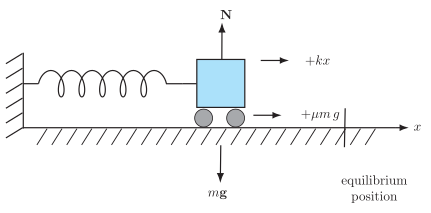
The figure shows a car pressed against a spring that is fixed to a wall. The spring is compressed, and the car sits on a hatched surface — the hatching indicates a rough surface that provides friction. Four forces are drawn acting on the car: the normal force pointing upward, the weight pointing downward, the spring force pushing the car to the right (away from the wall), and the friction force also pointing to the right. The equilibrium position of the spring (where it is neither stretched nor compressed) is marked with a label.
The physical idea is straightforward: when you compress a spring and hold it in place, the spring pushes back. If you then release the car, the spring force accelerates it to the right. But because the surface is rough, friction also acts — and in this diagram, both the spring force and friction point in the same direction (to the right). That tells you the car is being held against the spring by some external agent (perhaps your hand), and the forces shown are the ones acting on the car at the instant it is released. The spring force is , where is the spring constant and is the compression measured from the equilibrium position. The friction force is kinetic friction, , and it opposes the motion — but here, since the car is about to move right, friction acts to the right as well? That seems contradictory. Let's check the sign convention.
The figure labels friction as pointing right. This is only correct if the car is being pushed to the left by an external force (your hand) and the spring is compressed. In that case, the car is stationary, and static friction acts to the right to prevent it from being pushed left. Once released, the spring pushes right, and kinetic friction opposes that motion — so friction would then point left. The diagram likely shows the static case just before release, where friction balances the external push.
The key formula the textbook develops with this figure is the potential energy stored in a spring:
Here is the spring constant (a measure of the spring's stiffness, in N/m), and is the displacement from the spring's natural (unstretched) length. The formula gives the energy stored in the spring when it is compressed or stretched by . The work done by the spring force as it returns to equilibrium is the negative of the change in this potential energy: . …