Business Studies · Ch 6 — Staffing
Recruitment
Recruitment
The Core Idea of Recruitment
Recruitment is the very first step in building a workforce. It is the process of finding possible candidates for a job and then motivating them to apply for it. Think of it as a bridge between an organisation that has a vacancy and the people who might fill it. The textbook defines it as "the process of searching for prospective employees and stimulating them to apply for jobs in an organisation."
The entire purpose of recruitment is to attract a pool of applicants who have the right qualifications and characteristics. It does not involve choosing the final person — that is the job of selection, which comes next. Recruitment only locates people and invites them to apply.
The Activities Involved in Recruitment
The process is not a single step. It involves a series of actions:
- Identifying the different sources from which labour can be obtained.
- Assessing how valid or useful each source is.
- Choosing the most suitable source or sources.
- Inviting applications from prospective candidates for the vacancies. Advertising is a common part of this process. It can happen through newspapers, professional publications, job centres, campus interviews, or even advertisements placed in shop windows.
Sources of Recruitment: The Two Broad Categories
The required positions can be filled either from within the organisation or from outside. This gives us two main sources of recruitment: Internal and External.
Internal Sources
Internal recruitment means filling vacancies from people who are already working in the organisation. There are two important internal sources: transfers and promotions.
Transfers
A transfer is the shifting of an employee from one job to another, one department to another, or from one shift to another. The key point is that there is no substantive change in the employee's responsibilities, status, or salary. It is a horizontal movement.
Transfers are useful in several ways:
- They help fill vacancies in one branch by moving employees from an overstaffed department.
- They help avoid terminating employees when work in a particular area reduces.
- They can be used to resolve individual problems or grievances.
- They serve as a tool for training, allowing employees to learn different jobs.
A common mistake is to think a transfer always means a promotion. It does not. A transfer is a lateral move; a promotion is a vertical move.
Promotions
A promotion is the shifting of an employee to a higher position. This comes with higher responsibilities, better facilities, increased status, and a higher pay. It is a vertical movement.
Promotions have a powerful psychological impact. They improve employee motivation, loyalty, and satisfaction. A single promotion at a higher level can create a chain of promotions at lower levels, which keeps the entire workforce motivated.
Merits of Internal Sources
- Motivation: Employees work harder because they see a clear path for growth. A promotion at the top can trigger a chain of promotions below, boosting morale across the organisation.
- Simpler and More Reliable Selection: The organisation already knows the candidates. Evaluating them is more accurate, economical, and reliable than assessing an unknown outsider.
- Reduced Training Costs: Transfers act as on-the-job training for higher roles. Employees recruited internally do not need induction training because they already understand the organisation's culture and processes.
- Workforce Balancing: Transfers allow the organisation to shift employees from departments with surplus staff to those facing a shortage.
- Cost-Effective: Filling jobs internally is cheaper than advertising and processing external applications.
Limitations of Internal Sources
- Inbreeding: If the organisation relies only on internal recruitment, it stops the "infusion of new blood." This limits the scope for fresh talent and new ideas.
- Lethargy: If employees are sure of time-bound promotions, they may become complacent and stop working hard.
- Not Suitable for New Enterprises: A new organisation cannot use internal sources because it does not have existing employees. No organisation can fill all its vacancies from within.
- Hampers Competition: The spirit of healthy competition among employees may be reduced.
- Reduced Productivity: Frequent transfers can disrupt workflow and lower the overall productivity of the organisation.
External Sources
An enterprise must look outside when internal sources are insufficient or when existing employees do not meet the eligibility criteria for the job. External recruitment provides a wider choice and brings new talent into the organisation.
Types of External Sources
The textbook lists ten common external sources:
- Direct Recruitment: A notice is placed on the organisation's noticeboard specifying the job details. Job seekers assemble on a given date, and selection happens on the spot. This is used for casual vacancies of unskilled or semi-skilled jobs. These workers are called casual or 'badli' workers and are paid daily wages. It is very inexpensive as it involves no advertising cost.
- Casual Callers: Many organisations keep a database of unsolicited applicants who walk in or write in on their own. This list can be screened when vacancies arise. The main advantage is that it reduces recruitment costs.
- Advertisement: This is used when a wider choice is required, especially for senior positions. Advertisements are placed in newspapers or trade journals. The advantage is that detailed information about the job and the organisation can be provided. The disadvantage is that it can attract a flood of responses, many from unsuitable candidates.
- Employment Exchange: Government-run employment exchanges are a good source for unskilled and skilled operative jobs. In some cases, the law makes it compulsory for organisations to notify vacancies to these exchanges. They act as a link between job seekers and employers. A limitation is that their records are often not up to date, and many referred candidates may not be suitable.
- Placement Agencies and Management Consultants: These are private agencies that provide a nationwide service. They compile biodata of many candidates and recommend suitable names to their clients for a fee. They are useful when extensive screening is needed. Management consultancy firms specialise in recruiting technical, professional, and managerial personnel, especially for middle and top-level positions.
- Campus Recruitment: Colleges and institutes of management and technology are a popular source for technical, professional, and managerial jobs. Big organisations maintain close ties with universities and vocational schools to recruit qualified personnel directly from the campus.
- Recommendations of Employees: Applicants introduced by current employees, or their friends and relatives, can be a good source. Because the recommending employee knows both the company and the candidate, a form of preliminary screening takes place. Such candidates are likely to be reliable.
- Labour Contractors: Labour contractors maintain close contacts with labourers and can provide a required number of unskilled workers at short notice. The disadvantage is that if the contractor leaves the organisation, all the workers employed through him may also leave. …
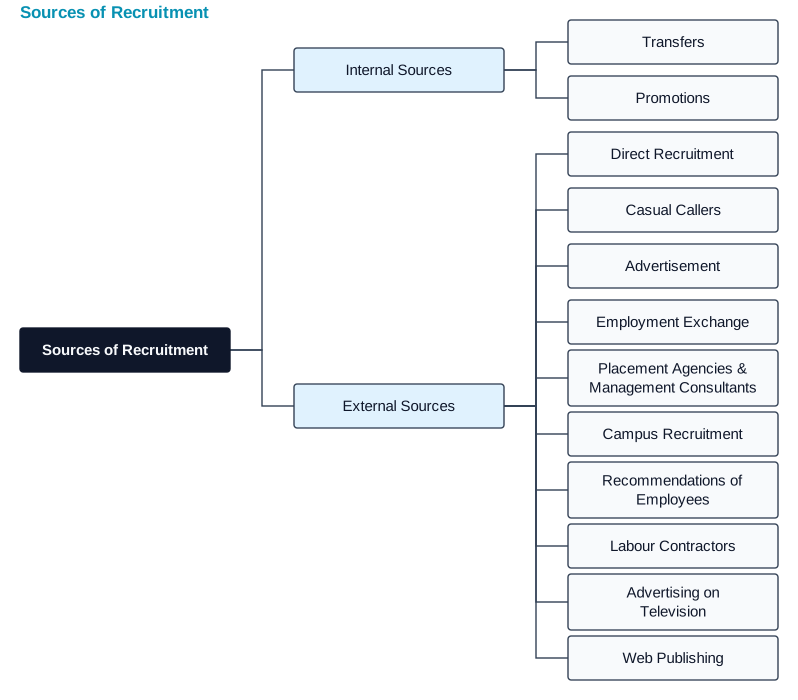
The required positions can be filled either from within the organisation (Internal Sources — Transfers, Promotions) or from outside it (External Sources — the ten avenues discussed below: Direct Recruitment, Casual Callers, Advertisement, Employment Exchange, Placement Agencies & Management Consultants, Campus Recruitment, Recommendations of Employees, La …
Drawn by us to help you understand the concept clearly, and verified to make sure it's accurate. For exams, practice from your NCERT textbook's own diagram.
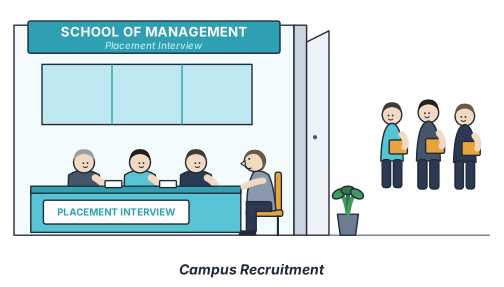
The textbook illustrates external source (vi) — Campus Recruitment — with a small cartoon of a "School of Management / Placement Interview" booth: an interview panel seated behind a desk, and candidates waiting outside with their folders.
Campus recruitment means colleges and institutes of management and technology becoming a recruitment channel in their own right. Organisations maintain a close liaison with universities, vocational schools and management institutes so they can recruit qualified personnel for technical, professional and managerial jobs directly from the graduating batch, rather than waiting for candidates to respond to an open advertisement. The textbook calls this "a well-established practice of businesses," and it remains one of the most efficient external …
When Lenovo India decided to strengthen its diversity numbers, it decided to tap into its referral system. The company asked its employees to recommend candidates, and decided to reward those who successfully recommended more women for the same roles. As employee referrals become an established method to hire quality lateral talent, companies are using technology platforms to build a steady talent pipeline through referrals. A majority of companies (nearly 41%, according to one study) across India use top technology for referral hires. According to the study India Recruiting Trends 2016 conducted by LinkedIn Talent Solutions, employee referrals are on the rise. This year, referrals were the top source of quality hires. “Nearly 55% of talent leaders see employee referral programmes as the top source of quality hire,” says Irfan Abdulla, director, talent solutions, LinkedIn India. Top players such as Coca-Cola, Infosys, Genpact, Capgemini, Deloitte, Dabur, Jubilant and more are reporting that over 40% of their hires come through referrals. …