Physics · Ch 3 — Current Electricity
Electrical Energy, Power
Electrical Energy, Power
Why Does a Conductor Get Hot When Current Flows?
When current flows through a conductor, the moving charges (electrons) collide with the atoms of the material. These collisions transfer energy from the electrons to the atoms, making them vibrate more. This increased vibration is what we experience as heat. The key idea is that the electrical energy supplied by the source is converted into heat energy in the resistor.
Deriving the Power Dissipated
Consider a conductor with a potential difference across it and a steady current flowing through it.
- In a small time interval , the amount of charge that flows is .
- This charge loses potential energy as it moves from the higher potential end to the lower potential end. The loss in potential energy is:
The negative sign indicates a decrease in potential energy.
-
If charges moved without any resistance, this lost potential energy would become kinetic energy. However, due to collisions, the energy is not converted to kinetic energy of the charges but is instead transferred to the conductor's atoms as heat.
-
Therefore, the energy dissipated as heat in the conductor during time is the amount of potential energy lost:
- Power is defined as the energy dissipated per unit time. So, the power dissipated in the conductor is:
This is the fundamental formula for electrical power.
Alternative Forms Using Ohm's Law
Since Ohm's law states (where is the resistance), we can substitute to get two other very useful forms for the power dissipated:
These three expressions (, , ) are equivalent for ohmic conductors. The power dissipated is often called ohmic loss.
Application: Power Transmission
A crucial application of these ideas is in transmitting electrical power over long distances.
- The Goal: To deliver a certain power to a device (e.g., a city) using transmission cables that have a total resistance .
- The Problem: The cables themselves dissipate power as heat, which is wasted. This wasted power is . …
Drawn by us to help you understand the concept clearly, and verified to make sure it's accurate. For exams, practice from your NCERT textbook's own diagram.
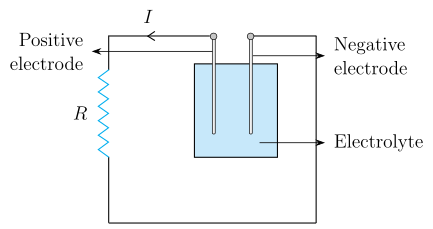
The figure shows a simple closed-loop circuit consisting of a resistor and a cell. On the left side of the loop is a zig-zag symbol representing the resistor, labelled R. The top wire of the loop carries a current I (indicated by an arrowhead pointing to the right). On the right side of the loop is a rectangular container (beaker) filled with shaded liquid — the electrolyte. Two vertical rods dip into the electrolyte from above: the left rod is labelled Positive electrode and the right rod is labelled Negative electrode. Together, the resistor and the cell form one continuous rectangular loop.
The physical idea this figure teaches is the conversion of chemical energy into electrical energy and then into heat. The cell (the beaker with electrodes and electrolyte) is the source of energy. Chemical reactions inside the cell maintain a potential difference between its terminals, which drives a steady current I through the external resistor R. As the current flows through the resistor, the moving charges collide with the atoms of the resistor, transferring kinetic energy to them. This makes the atoms vibrate more vigorously — the resistor heats up. The energy dissipated as heat in the resistor comes from the chemical energy of the electrolyte inside the cell.
The key formula developed alongside this figure is the power dissipated in a resistor:
where:
- is the power (energy dissipated per unit time) in the resistor,
- is the current flowing through the resistor,
- is the potential difference across the resistor.
Using Ohm's law (), this can also be written as:
…