Q.(a) Give the flow chart of Krebs cycle. OR
You're viewing a preview — the full solution, concept, methods & PYQ mapping are locked.
Start your 14-day free trial to unlock the full solution →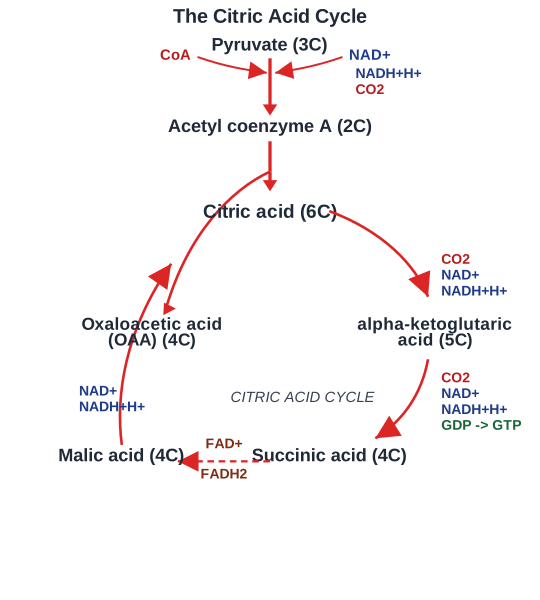
The Krebs cycle is a closed loop of eight enzyme-catalysed steps in the mitochondrial matrix that fully oxidizes the 2-carbon acetyl group of acetyl-CoA, regenerating oxaloacetate at the end and releasing 2 CO2, 3 NADH, 1 FADH2, and 1 ATP per turn.
The Krebs cycle (Citric Acid Cycle / TCA cycle) takes place in the mitochondrial matrix, and each turn processes one molecule of acetyl-CoA (derived from pyruvate oxidation). The flow of the cycle is as follows:
-
Acetyl-CoA (2C) + Oxaloacetate (4C) → Citrate (6C) — catalysed by citrate synthase; CoA is released.
-
Citrate → Isocitrate — an isomerization step, catalysed by aconitase.
-
Isocitrate → α-Ketoglutarate (5C) + CO2 + NADH — an oxidative decarboxylation, catalysed by isocitrate dehydrogenase (1st CO2 released, 1st NADH formed).
-
α-Ketoglutarate → Succinyl-CoA (4C) + CO2 + NADH — another oxidative decarboxylation, catalysed by α-ketoglutarate dehydrogenase (2nd CO2 released, 2nd NADH formed).
-
Succinyl-CoA → Succinate + ATP (via GTP) — substrate-level phosphorylation, catalysed by succinyl-CoA synthetase (the only direct ATP/GTP generated within the cycle itself).
-
Succinate → Fumarate + FADH2 — an oxidation step, catalysed by succinate dehydrogenase (embedded in the inner mitochondrial membrane, also part of Complex II of the ETC).
-
Fumarate → Malate — a hydration step, catalysed by fumarase.
…
Unlock everything free for 14 days
- Full step-by-step solutions
- Concept-first explanations
- Methods, shortcuts & mistakes
- PYQ mapping + timed mock tests
Full access for 14 days. No credit card required.