Q.(a) Explain the structure of benzene.
You're viewing a preview — the full solution, concept, methods & PYQ mapping are locked.
Start your 14-day free trial to unlock the full solution →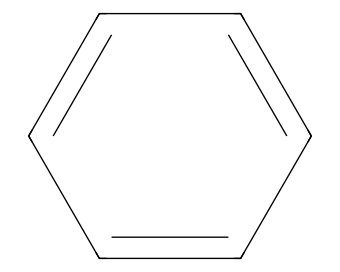
This is a 5-mark either/or question; both alternatives are answered below.
(a) Benzene is a planar, regular hexagonal ring of six sp2 carbons with equal C-C bonds and six delocalised π-electrons (aromatic); (b) the Friedel-Crafts reaction is electrophilic alkylation/acylation of benzene, and pollution is controlled by clean fuels, effluent treatment, catalytic converters, waste management and afforestation.
PART (a) — Structure of benzene:
- Benzene has the molecular formula C6H6 and is a cyclic molecule containing a ring of six carbon atoms.
- The ring is planar and a regular hexagon; each carbon atom is sp2 hybridised, forming sigma bonds to two neighbouring carbons and one hydrogen, so all bond angles are 120°.
- All six carbon-carbon bond lengths are equal (about 139 pm), a value intermediate between a normal C-C single bond (154 pm) and a C=C double bond (134 pm). This shows the bonds are neither pure single nor pure double.
- Each carbon has one unhybridised p-orbital perpendicular to the ring; these six p-orbitals overlap sideways to form a delocalised π-electron cloud above and below the plane of the ring.
- Because of this delocalisation, benzene is a resonance hybrid of the two Kekulé structures and is unusually stable (aromatic); it obeys Huckel's rule (4n+2 π electrons, with n = 1, giving 6 π electrons).
PART (b)(i) — Friedel-Crafts reaction:
The Friedel-Crafts reaction is an electrophilic aromatic substitution on benzene carried out in the presence of anhydrous aluminium chloride (a Lewis-acid catalyst). It is of two types:
- Alkylation: benzene + alkyl halide → alkylbenzene. C6H6 + CH3Cl --(anhyd. AlCl3)--> C6H5CH3 (toluene) + HCl.
- Acylation: benzene + acyl chloride → aromatic ketone. C6H6 + CH3COCl --(anhyd. AlCl3)--> C6H5COCH3 (acetophenone) + HCl.
PART (b)(ii) — Methods to protect the environment from pollution: …
Unlock everything free for 14 days
- Full step-by-step solutions
- Concept-first explanations
- Methods, shortcuts & mistakes
- PYQ mapping + timed mock tests
Full access for 14 days. No credit card required.