Physical Education · Ch 6 — Test and Measurement in Sports
Johnson - Metheny Test of Motor Education
Johnson - Metheny Test of Motor Education
Johnson - Metheny Test of Motor Education
The Johnson-Metheny Test battery is a revised version of the Johnson Educability Test, which was designed in 1932. The purpose of the original Johnson battery was to measure neuromuscular skill capacity, and it had ten items. In 1938 Metheny studied the test and eliminated six of the items, leaving a battery of four motor stunts:
- Front Roll
- Back Roll
- Jumping Half-Turns
- Jumping Full-Turns
Boys perform all four stunts; girls perform three. The test measures motor educability - how easily and well a person can learn new motor skills - a topic that appears regularly in CBSE Class 12 Physical Education questions and answers.
Test Area
The mat area is 15 feet long and 2 feet wide. The 15-foot length is divided into ten sections of 18 inches each. The transverse lines are 3/4 inch and 3 inches wide alternately, with the centres of the lines 18 inches apart. Another 3/4-inch wide line is marked lengthwise down the middle of the mat.
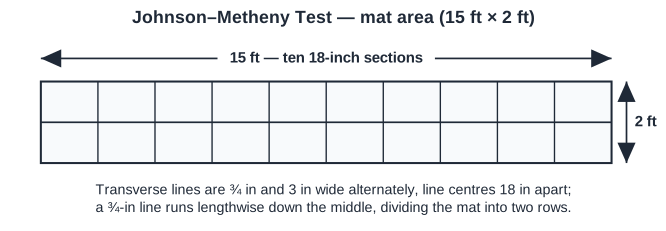
Drawn by us to help you understand the concept clearly, and verified to make sure it's accurate. For exams, practice from your textbook's own diagram.
A diagram of the Johnson-Metheny test mat, shown as a long horizontal rectangle 15 feet long and 2 feet wide. Nine transverse lines divide the length into ten equal 18-inch sections, and a single lengthwise line down the middle splits the mat into two rows of rectangles. A double-headed horizontal arrow above the mat marks the full 15-foot length, and a …
Procedure and Scoring
1. Front Roll. Ignoring the long middle dividing line, the subject starts outside the marked area and performs two front rolls - one up to the 7.5-foot (the 3-inch wide centre) line, and the second in the other 7.5-foot half - without touching the limits or over-reaching the zones.
Scoring: each correct roll scores 5 points (maximum 10 for two rolls). Deduct 2 points for over-reaching a side line (right or left) on each roll, 1 point for over-reaching the end limit on each roll, and the full 5 points when the subject fails to perform a true front roll.
2. Back Roll. This is similar to the front roll in both performance and scoring. The subject starts outside the marked area and performs two back rolls in the 2-foot lane - one up to the first half and the second in the second half.
3. Jumping Half-Turns. The subject starts with the feet on the first 3-inch line, jumps with both feet to the second 3-inch line while making a half turn (right or left), then jumps to the third line making a half turn in the opposite direction, and continues alternating half-turn directions to the fourth and fifth lines.
Scoring: perfect execution of four jumps = 10 points. Deduct 2 points for each wrong jump - when the subject fails to land with both feet on the 3-inch line, turns the wrong way, or both. …