Mathematics · Ch 7 — Applications of Differential Calculus
Applications in Optimization
Applications in Optimization
Optimization is the process of finding an extreme value (either maximum or minimum) of some quantity under given conditions.
Procedure for solving an extremum/optimization problem.
Step 1. Draw an appropriate figure and label the quantities relevant to the problem.
Step 2. Find an expression for the quantity to be maximized or minimized.
Step 3. Using the given conditions of the problem, reduce that expression to a single variable (eliminate the other variable(s) using the constraint).
Step 4. Determine the interval of possible values for this variable from the conditions given in the problem.
Step 5. Using the techniques of extremum — absolute extrema, the first derivative test, or the second derivative test — obtain the maximum or minimum.
Worked patterns behind Exercise 7.8's twelve problems:
- Box-folding (fixed sheet, cut-and-fold): express the box's volume as a single-variable function of the cut length, restrict to the physically valid interval, then apply the first derivative test.
- Nearest/farthest point on a curve: minimise the squared distance (never the square-root distance directly, since squaring avoids an unnecessary radical) subject to the curve's own equation, using implicit differentiation to bring in from the constraint.
- Maximise total receipts/production under a linear constraint: substitute the constraint into the revenue/receipt expression to reduce it to one variable, then apply the second derivative test.
- Minimum-perimeter / maximum-area rectangle under a fixed area or perimeter: substitute the constraint ( or ) to write the target quantity in one variable, and show algebraically that the optimal shape collapses to — a square. …
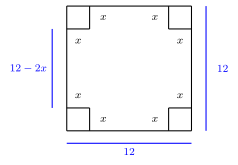
Drawn by us to help you understand the concept clearly, and verified to make sure it's accurate. For exams, practice from your textbook's own diagram.
What this figure shows. Optimization diagram: an open box formed by cutting equal squares of side x from each corner of a 12 by 12 square sheet; the base side bec …
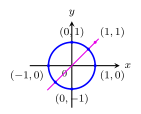
Drawn by us to help you understand the concept clearly, and verified to make sure it's accurate. For exams, practice from your textbook's own diagram.
What this figure shows. The unit circle x^2 + y^2 = 1 with the line through the origin and (1,1); the nearest and farthest points from (1,1) are (1/sqrt2, 1/sqrt2) and (-1/sq …