Mathematics · Ch 7 — Applications of Differential Calculus
Concavity, Convexity, and Points of Inflection
Concavity, Convexity, and Points of Inflection
A graph is said to be concave down (convex up) at a point if the tangent line there lies above the graph in the vicinity of the point; it is concave up (convex down) at a point if the tangent line lies below the graph nearby.
Definition 7.8 (repeated from §7.6.2's numbering — the second derivative version). Let be a function whose second derivative exists on an open interval . Then is:
- concave up on if is strictly increasing on ;
- concave down on if is strictly decreasing on . Analytically, the concavity of a differentiable is captured by testing the second derivative directly: Theorem 7.11 (Test of Concavity).
(i) If on an open interval , then is concave up on .
(ii) If on an open interval , then is concave down on .
(1) Any local maximum of a function that is convex-upward (concave-down) on is also its absolute maximum on .
(2) Any local minimum of a function that is convex-downward (concave-up) on is also its absolute minimum on .
(3) There is only ever one absolute maximum (and one absolute minimum) on an interval, but there can be several local maxima or minima.
Definition 7.9 (Points of Inflection). The points where the graph of changes from "concave up to concave down" or "concave down to concave up" are called points of inflection of .
Theorem 7.12 (Test for Points of Inflection).
(i) If exists and changes sign as passes through , then is a point of inflection of the graph of .
(ii) If exists at a point of inflection, then .
Locating candidate inflection points. For a "smooth" curve (no sharp corners), points where might change sign happen either where or where does not exist.
Three cautions that go with this test:
- may fail to exist at a genuine point of inflection — e.g. at . …
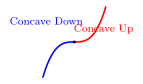
Drawn by us to help you understand the concept clearly, and verified to make sure it's accurate. For exams, practice from your textbook's own diagram.
What this figure shows. Schematic illustrating concavity: a curve that is concave down (convex up) on the left and concave up (convex down) on the right, meeting at a point …
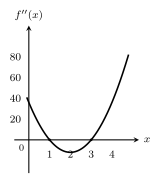
Drawn by us to help you understand the concept clearly, and verified to make sure it's accurate. For exams, practice from your textbook's own diagram.
What this figure shows. Graph of f''(x) = 12(x-1)(x-3) for the curve f(x)=(x-1)^3(x-5): an upward parabola with roots x=1 and x=3 (the points of inflection), negative between them and positive outside. The y-axis is compres …