Mathematics · Ch 6 — Applications of Vector Algebra
Properties of the Scalar Triple Product
Properties of the Scalar Triple Product
Theorem 6.2. For any three vectors : . Proof: both equal the same determinant , up to the row swaps then which cancel each other's sign flip.
Because of Theorem 6.2, dot and cross can be freely interchanged inside a scalar triple product as long as their relative order (which vectors are crossed, which is dotted) and the cyclic order of the three vectors is kept — dot lies outside the bracket, cross lies between the first two vectors inside it. Chaining this with the fact that the dot product is commutative gives:
Notation. is written — read "box " — because is the volume of a box (rectangular parallelepiped); it is also called the box product.
Properties.
- Cyclic invariance: — permuting the three vectors cyclically never changes the value.
- Odd-permutation sign flip: swapping any TWO of the three vectors multiplies the value by : .
- Linearity in each slot (Theorem 6.3): and , and similarly in the 2nd and 3rd slots — the scalar triple product distributes over vector addition and pulls out scalar multiples, exactly like a determinant's row-linearity.
Theorem 6.4 (coplanarity test). for non-zero if and only if are coplanar. (Reason: lies in the plane parallel to both .)
Theorem 6.5. are coplanar iff there exist scalars , not all zero, with (a genuine linear dependence). …
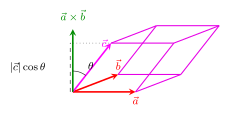
Drawn by us to help you understand the concept clearly, and verified to make sure it's accurate. For exams, practice from your textbook's own diagram.
What this figure shows. Fig. 6.17 - Geometric meaning of the scalar triple product (a x b).c as the volume of the parallelepiped with coterminus edges a, b, c; a x b is normal to the base and |c|cos(t …