Mathematics · Ch 2 — Complex Numbers
Geometrical Representation of Conjugate of a Complex Number
Geometrical Representation of Conjugate of a Complex Number
The complex conjugate of is denoted . To find the conjugate of , simply replace by throughout . For instance, is the conjugate of .
Key fact. The product of a complex number with its own conjugate is always a real number:
For instance: .
Geometric picture. Since conjugation flips only the sign of , is obtained from by reflecting across the real axis in the Argand plane — the point and its conjugate are mirror images through the -axis. …
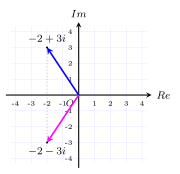
Drawn by us to help you understand the concept clearly, and verified to make sure it's accurate. For exams, practice from your textbook's own diagram.
What this figure shows. Conjugate as reflection on the real axis: and its conjugate $-2-3i …
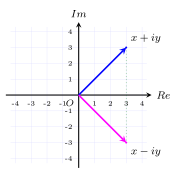
Drawn by us to help you understand the concept clearly, and verified to make sure it's accurate. For exams, practice from your textbook's own diagram.
What this figure shows. Conjugate as reflection on the real axis: and its conjugate $x-iy …