Mathematics · Ch 2 — Complex Numbers
Geometry and Locus of Complex Numbers
Geometry and Locus of Complex Numbers
This section studies the geometric interpretation of a complex number in the complex plane, and how to convert a condition on (given in terms of or ) into an ordinary Cartesian equation in — the equation of the locus traced out by .
Definition (circle). A circle is the locus of a point that moves in a plane such that its distance from a fixed point in that plane is always a constant. The fixed point is the centre, and the constant distance is the radius.
Complex form of the equation of a circle. Since is the distance from to the fixed point , the locus of satisfying
consists of all points at distance from — exactly a circle with centre and radius . Correspondingly:
- represents the points interior to the circle;
- represents the points exterior to the circle.
For instance, (i.e. ) gives , i.e. : a circle centred at the origin, radius . An equation such as () is first divided through by and rewritten as , from which the centre and radius can be read off directly.
General loci. More general conditions on also trace out recognisable curves once translated to Cartesian form:
- (equidistant from two fixed points ) always gives the perpendicular bisector of the segment joining and — a straight line, not a circle.
- Conditions phrased with , or (e.g. , , ) become ordinary Cartesian equations once is substituted and the real/imaginary parts are separated — the result may be a line, a circle, or another simple curve.
- An argument condition, e.g. , fixes the angle subtended by the segment joining two fixed points, and typically traces an arc of a circle. …
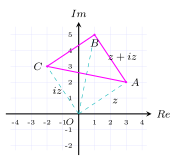
Drawn by us to help you understand the concept clearly, and verified to make sure it's accurate. For exams, practice from your textbook's own diagram.
What this figure shows. Fig 2.22: for , the points , , form an isosceles right triangle; dashed vectors show , , fro …
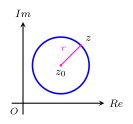
Drawn by us to help you understand the concept clearly, and verified to make sure it's accurate. For exams, practice from your textbook's own diagram.
What this figure shows. Fig 2.23: the circle — locus of points at a fixed distance from the centre …
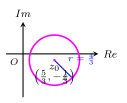
Drawn by us to help you understand the concept clearly, and verified to make sure it's accurate. For exams, practice from your textbook's own diagram.
What this figure shows. Fig 2.24: the circle , i.e. , with centre and radius $ …
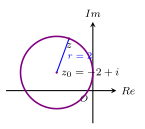
Drawn by us to help you understand the concept clearly, and verified to make sure it's accurate. For exams, practice from your textbook's own diagram.
What this figure shows. Fig 2.25: — the interior of the circle of centre and radius $r …