Mathematics · Ch 2 — Complex Numbers
Polar Form of a Complex Number
Polar Form of a Complex Number
Polar coordinates form another set of parameters characterising the vector from the origin to a point , using magnitude and direction instead of horizontal/vertical components. The polar coordinate system has a fixed point (the pole) and a horizontal half-line from (the initial line or polar axis). For a point , if is the distance from to and is the angle (measured counter-clockwise from the initial line) to the line , then are the polar coordinates of .
Superimposing this on the ordinary rectangular system gives
so any nonzero complex number can be expressed as .
Definition. Let be polar coordinates of the point corresponding to . The polar (trigonometric) form of is
Here is the modulus of (the absolute value, as before), and is called the argument (or amplitude) of , written .
- If , is undefined — polar coordinates always assume .
- If has polar coordinates , its conjugate has polar coordinates .
Squaring and adding (1) and (2) gives ; dividing (2) by (1) gives .
General argument vs. principal argument. can take infinitely many values, all differing by an integer multiple of — every value of satisfying in the correct quadrant for is an argument of , and the full set of such values is denoted . There is a unique value of satisfying ; this is called the principal argument, . In general, .
To find in practice: compute (the reference angle, always taken as the acute angle from the calculator) and then adjust for the quadrant containing :
| Quadrant | sign of | |
|---|---|---|
| I | ||
| II | ||
| III | ||
| IV |
For instance, the principal argument and (general) argument of are respectively, matching the point's position on the axes.
Properties of arguments (parallel to the modulus properties):
and has the equivalent alternate forms (adding any whole number of full turns changes nothing).
Multiplication and division in polar form. If and , then, using the cosine/sine angle-addition formulas, …
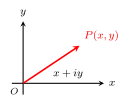
Drawn by us to help you understand the concept clearly, and verified to make sure it's accurate. For exams, practice from your textbook's own diagram.
What this figure shows. Fig 2.26: rectangular coordinates — the complex number as the position vector to …
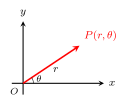
Drawn by us to help you understand the concept clearly, and verified to make sure it's accurate. For exams, practice from your textbook's own diagram.
What this figure shows. Fig 2.27: polar coordinates — the point given by distance from the pole and inclination of from the …
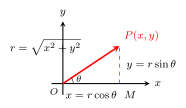
Drawn by us to help you understand the concept clearly, and verified to make sure it's accurate. For exams, practice from your textbook's own diagram.
What this figure shows. Fig 2.28: polar coordinates superimposed on rectangular — , with along the axis to and vertic …
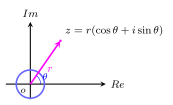
Drawn by us to help you understand the concept clearly, and verified to make sure it's accurate. For exams, practice from your textbook's own diagram.
What this figure shows. Fig 2.29: polar (trigonometric) form — modulus as the vector length and argument as the angle from the pos …
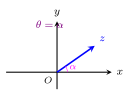
Drawn by us to help you understand the concept clearly, and verified to make sure it's accurate. For exams, practice from your textbook's own diagram.
What this figure shows. Fig 2.30: principal argument, I-Quadrant — for in the first quadrant, (acute angle measured from the posi …
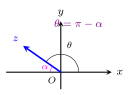
Drawn by us to help you understand the concept clearly, and verified to make sure it's accurate. For exams, practice from your textbook's own diagram.
What this figure shows. Fig 2.31: principal argument, II-Quadrant — for in the second quadrant, ( acute angle from the nega …
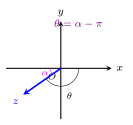
Drawn by us to help you understand the concept clearly, and verified to make sure it's accurate. For exams, practice from your textbook's own diagram.
What this figure shows. Fig 2.32: principal argument, III-Quadrant — for in the third quadrant, ( acute from the negative x-axis; measured clockw …
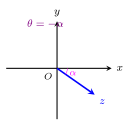
Drawn by us to help you understand the concept clearly, and verified to make sure it's accurate. For exams, practice from your textbook's own diagram.
What this figure shows. Fig 2.33: principal argument, IV-Quadrant — for in the fourth quadrant, (acute angle below the positive x-axis, measu …