Mathematics · Ch 8 — Differentials and Partial Derivatives
Partial Derivatives
Partial Derivatives
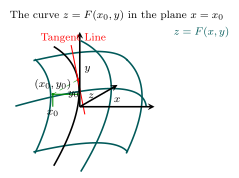
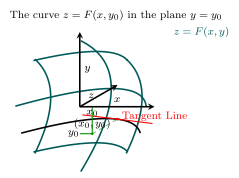
Motivation. For , holding fixed turns into a function of alone, whose graph is the curve cut from the surface by the plane ; its ordinary derivative with respect to , evaluated at , is the slope of the tangent to that curve — this is the rate of change of in the -direction only, with held fixed. Symmetrically for .
Definition 8.8 (Partial Derivative). Let , , .
- has a partial derivative with respect to at if exists; the limit value is denoted , also written .
- has a partial derivative with respect to at if exists; the limit value is , also written .
Read as "partial ", as "partial ", and as "partial by partial " (or "dho by dho "). If has a partial derivative w.r.t. at every point of , then is itself a new function on . Partial derivatives for three or more variables are defined exactly the same way, one variable at a time with all others frozen. Mechanically, all the usual rules of differentiation (sum, product, quotient, chain) apply unchanged — the only new bookkeeping is that every variable except the one being differentiated is treated as a constant.
Worked example. For , holding fixed and differentiating w.r.t. : ; holding fixed and differentiating w.r.t. : . Evaluate at any given point exactly as with a one-variable derivative. Second-order and mixed partial derivatives. Since is again a function of , it can be partially differentiated again:Watch out
Unlike one variable — where differentiability always implies continuity — the existence of both and at a point does NOT guarantee is continuous there. Example: if , if . Along the -axis () or the -axis (), , so both and exist; yet along the line with , , so is not continuous at .
Higher (third and beyond) mixed partials continue the same pattern, one variable at a time, e.g. . …
Drawn by us to help you understand the concept clearly, and verified to make sure it's accurate. For exams, practice from your textbook's own diagram.
What this figure shows. Fig 8.11 Geometric meaning of the partial derivative w.r.t. y: the surface z=F(x,y) cut by the plane x=x0 gives the curve z=F(x0,y), whose tangent line at (x0,y0) has slope the …
Drawn by us to help you understand the concept clearly, and verified to make sure it's accurate. For exams, practice from your textbook's own diagram.
What this figure shows. Fig 8.12 Geometric meaning of the partial derivative w.r.t. x: the surface z=F(x,y) cut by the plane y=y0 gives the curve z=F(x,y0), whose tangent line at (x0,y0) has slope the …