Question 56 of 71
Q.(a) Draw the graph of in and in . OR
(b) Find the equation of the circle passing through the points , and .
Puducherry TnboardTamil Nadu HSC (DGE) Board 2020Subjective· 5mImportance★★★★★
79% · 56/71 Questions
You're viewing a preview — the full solution, concept, methods & PYQ mapping are locked.
Start your 14-day free trial to unlock the full solution →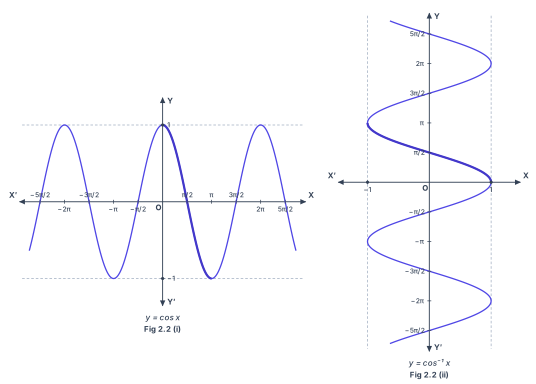
(a) describes and plots on and its inverse on , noting they are reflections of each other in ; (b) fits the general circle through three given points by solving the resulting linear system for .
(a) Graphs of on and on
- , : domain , range . It is continuous and strictly decreasing throughout (since on ).
- Key points: , , , , . The curve starts at the top-left, falls smoothly, crosses the -axis at , and ends at the bottom-right — one full descending arch of the cosine wave.
- , : domain , range . Being the inverse of restricted to , it is also continuous and strictly decreasing.
- Key points (swap coordinates of the points above): , , , , .
- Since is the inverse function of , its graph is exactly the mirror image of the graph in the line ; both are drawn on the same axes to show this symmetry.
(b) Circle through
- Let the circle be .
- At : … (1) …
Unlock everything free for 14 days
- Full step-by-step solutions
- Concept-first explanations
- Methods, shortcuts & mistakes
- PYQ mapping + timed mock tests
Full access for 14 days. No credit card required.