Mathematics · Ch 10 — Ordinary Differential Equations
Mixture problems
Mixture problems
Mixing problems occur constantly in the chemical industry, and a single bookkeeping idea handles them all.
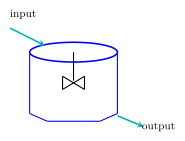
Setup. A substance flows into a container of mixture at a constant rate, the mixture is kept uniform by stirring, and the uniform mixture simultaneously flows out at another (possibly different) rate (Fig. 10.2). Let denote the amount of present at time ; if IN denotes the rate at which enters and OUT the rate at which it leaves, then
Here IN is (inflow concentration) (inflow rate), while OUT is (current concentration, i.e. current amount / current volume) (outflow rate) — so OUT typically depends on itself, making the resulting equation linear (rather than separable) in .
Worked pattern (Example 10.30). A -litre tank holds g of dissolved salt. Brine enters at L/min, each litre carrying g of salt (so IN g/min); the well-stirred mixture leaves at the same L/min, so the outflow rate of salt is (fraction of tank drained per minute) (current amount) g/min. This gives the linear equation
i.e. . Integrating: ; the initial condition at fixes , giving
as the amount of salt present at any time . …
Drawn by us to help you understand the concept clearly, and verified to make sure it's accurate. For exams, practice from your textbook's own diagram.
What this figure shows. A tank with an inflow arrow labelled 'input' bringing brine in at a fixed rate and concentration, and an outflow arrow labelled 'output' draining the uniformly-stirred mixture at another fixed rate, illustrating the IN/OUT bookkeeping used to set up the mixture differen …