Mathematics · Ch 5 — Two Dimensional Analytical Geometry-II
Ellipse
Ellipse
An ellipse is the locus with : its distance from the focus is less than its distance from the directrix, scaled by .
(i) Standard form. Let be a focus, a directrix, . Let divide (where ) internally and externally in the ratio , with and (their midpoint) the origin; is the -axis. Working through gives and , so the focus is and the directrix is . Applying to a moving point and simplifying (using , a positive quantity since ) gives
the ellipse in standard form, symmetric about both axes. By symmetry there is a second focus with matching directrix — unlike the parabola, the ellipse (and, similarly, the hyperbola) has two foci and two directrices.
Vocabulary (Definition 5.4). (length ) is the major axis; (length , where ) is the minor axis; are the semi-major/semi-minor axes. Taking , so : the vertices are , foci , directrices . Substituting into the equation, as in the focus-side latus rectum, gives , so the latus rectum has length .
Theorem 5.5 (sum of focal distances). For any point on the ellipse, (constant — in fact this is often taken as the defining "string-and-two-pins" construction of an ellipse). Proof sketch: using the focus-directrix relation on each focus separately, and , so regardless of .
Remarks. As , and the ellipse rounds into a circle (the directrix recedes to infinity, and , i.e. — which is exactly what "directrix at infinity" means); this is why the circle is sometimes called the degenerate ellipse. The circle on the major axis as diameter, , is the auxiliary circle (used to parametrise the ellipse, §5.5.1); the circle on the minor axis as diameter, , is the incircle. …
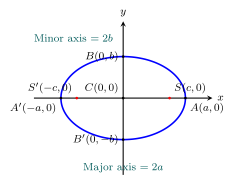
Drawn by us to help you understand the concept clearly, and verified to make sure it's accurate. For exams, practice from your textbook's own diagram.
What this figure shows. Centre , both foci , both vertices , both directrices and the latus rectum for . …
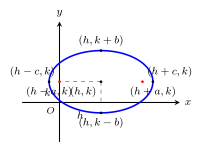
Drawn by us to help you understand the concept clearly, and verified to make sure it's accurate. For exams, practice from your textbook's own diagram.
What this figure shows. Two orientations of a shifted ellipse — major axis parallel to the -axis and parallel to the -axis — each labelled with its shifted centre, vertices and foci. …