Mathematics · Ch 5 — Two Dimensional Analytical Geometry-II
Parabola
Parabola
Since for a parabola, a parabola is simply the set of points equidistant from a fixed focus and a fixed directrix.
(i) Standard form, vertex at the origin. Let be the focus and the directrix; draw , and take the line (produced) as the -axis with the perpendicular bisector of as the -axis, so the origin is their intersection. Let , so and . For a moving point with , the defining condition (since ) gives
the parabola in standard form. The three other origin-vertex orientations follow by symmetry: (opens left), (opens up), (opens down).
Vocabulary (Definition 5.3). The line through the focus perpendicular to the directrix is the axis; where the axis meets the curve is the vertex; any chord through the focus is a focal chord; the focal chord perpendicular to the axis is the latus rectum, and its endpoints for are (found by substituting ), so its length is . The parabola is symmetric about the -axis (replacing by leaves the equation unchanged) and lies entirely on the side .
(ii) Vertex at . Shifting the origin to : when the axis is parallel to the -axis, the equation is ; when parallel to the -axis, . Summarised (with throughout):
| Equation | Vertex | Focus | Axis | Directrix | Latus rectum |
|---|---|---|---|---|---|
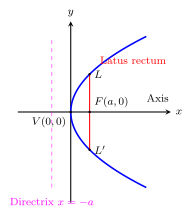
Drawn by us to help you understand the concept clearly, and verified to make sure it's accurate. For exams, practice from your textbook's own diagram.
What this figure shows. Focus , directrix , vertex, axis and the latus rectum through the focus perpendicular to the axis, for . …
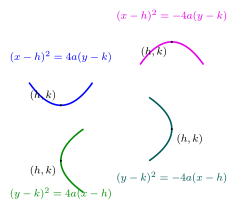
Drawn by us to help you understand the concept clearly, and verified to make sure it's accurate. For exams, practice from your textbook's own diagram.
What this figure shows. Four small sketches — opening right, left, up and down — each showing the vertex , the shifted focus and directrix for and . …