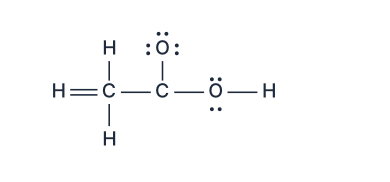
Q.The skeletal structure of as shown below is correct, but some of the bonds are shown incorrectly. Write the correct Lewis structure for acetic acid.
You're viewing a preview — the full solution, concept, methods & PYQ mapping are locked.
Start your 14-day free trial to unlock the full solution →The textbook gives a skeletal structure of with two bonds drawn incorrectly: a double bond between hydrogen and the methyl carbon (impossible — hydrogen can only ever form one bond), and a single bond between the carbonyl carbon and one oxygen (leaves both that carbon and that oxygen with an incomplete octet). Fixing both — H–C single, C=O double — gives the correct Lewis structure.
The structure exactly as given (incorrect)
    H   :O:
    |    |
H = C — C — O — H
    |
    H
This is the actual structure printed in the exercise. Two of its bonds are wrong, and the question asks you to identify and correct them — not to build a fresh structure from scratch.
Step 1: Find the chemically impossible bond
Look at the far left: the structure shows , a double bond between a hydrogen atom and the methyl carbon. This cannot be right. Hydrogen has exactly one valence electron, occupying a single 1s orbital — it can share that one electron in exactly one bond. A hydrogen atom can never be double-bonded to anything. This bond must be a plain single bond, .
Step 2: Check what that leaves incomplete
With the H–C bond corrected to single, count the bonds on each carbon:
- Left (methyl) carbon: three C–H single bonds + one C–C single bond = 4 bonds — octet satisfied. ✓
- Right (carbonyl) carbon: one C–C single bond + one C–O single bond (to the top oxygen) + one C–O single bond (to the –OH group) = only 3 bonds — octet incomplete.
- Top oxygen: shown with a single bond to carbon plus only 2 lone pairs (4 electrons) = 6 electrons total — octet incomplete (a singly-bonded terminal oxygen needs 3 lone pairs to reach 8; a doubly-bonded one needs 2).
Both the carbonyl carbon and the top oxygen are short an octet — that is the second error hiding in the given structure.
Step 3: Fix the second bond
The carbonyl carbon needs one more bond, and the top oxygen needs 2 more electrons to complete its octet. Both are fixed by the same single change: make the C–O bond to the top oxygen a double bond (C=O) instead of single.
- Carbonyl carbon now has: one C–C single bond + one C=O double bond + one C–O single bond (to –OH) = 4 bonds — octet satisfied. ✓
- Top oxygen now has: one C=O double bond (4 electrons) + 2 lone pairs (4 electrons) = 8 electrons — octet satisfied. ✓
Step 4: Verify the electron count …
Unlock everything free for 14 days
- Full step-by-step solutions
- Concept-first explanations
- Methods, shortcuts & mistakes
- PYQ mapping + timed mock tests
Full access for 14 days. No credit card required.