Q.Evaluate r!(n−r)!n!, when n=5, r=2.
🔒You're viewing a preview — the full solution, concept, methods & PYQ mapping are locked.
🔒 Start your 10-day free trial to unlock the full solution →Concept understanding — Permutations Without Repetition
Permutations Without Repetition – The Idea of Arranging Things
Imagine you have three different books on a shelf: a Physics book, a Chemistry book, and a Maths book. How many different ways can you arrange them in a row?
You could try listing them out:
- Physics, Chemistry, Maths
- Physics, Maths, Chemistry
- Chemistry, Physics, Maths
- Chemistry, Maths, Physics
- Maths, Physics, Chemistry
- Maths, Chemistry, Physics
That's 6 arrangements. Notice that each arrangement uses all three books exactly once — no book is repeated, and no book is left out. This is the core idea: permutations without repetition count the number of ways to arrange a set of distinct objects in order, using each object exactly once.
Why "Without Repetition"?
The phrase "without repetition" means that once you place an object in a position, you cannot use it again. In our book example, once you put the Physics book in the first slot, you cannot put it in the second or third slot. Each object appears exactly once in the arrangement.
This is different from "permutations with repetition" (like creating 3-letter codes from the letters A, B, C where you can reuse letters — e.g., AAA, AAB, etc.). Here, no repeats allowed.
The Counting Logic – Why Multiply?
Let's build the arrangement step by step for 3 distinct books:
- First position: You have 3 choices (any of the 3 books).
- Second position: After placing the first book, only 2 books remain — so 2 choices.
- Third position: Only 1 book is left — so 1 choice.
Total arrangements = 3×2×1=6.
This product 3×2×1 is called 3 factorial, written as 3!.
P(n)=n!=n×(n−1)×(n−2)×⋯×2×1
For n distinct objects, the number of permutations (arrangements in order) is n!.
What If You Only Arrange Some of Them?
Suppose you have 5 different books, but you only want to arrange 3 of them on a shelf. How many ways?
- First position: 5 choices
- Second position: 4 choices
- Third position: 3 choices
Total = 5×4×3=60.
This is a permutation of 5 objects taken 3 at a time, written as P(5,3) or 5P3.
P(n,r)=(n−r)!n!=n×(n−1)×⋯×(n−r+1)
Here n is the total number of distinct objects, and r is how many you are arranging. The formula works because:
- Numerator n! counts all arrangements of all n objects.
- Denominator (n−r)! removes the arrangements of the n−r objects you are not using.
Key Points to Remember
- Order matters — swapping two objects gives a different permutation.
- No repetition — each object is used at most once.
- For arranging all n objects: n!
- For arranging r out of n objects: (n−r)!n!
Common Mistake to Avoid …
Concept: Binomial coefficient (combinations)
The expression r!(n−r)!n! is the binomial coefficient (rn), which counts the number of ways to choose r objects from n distinct objects without regard to order.
Substituting n=5 and r=2:
2!(5−2)!5!=2!⋅3!5! …
We substitute n=5 and r=2 into the combination formula r!(n−r)!n! and simplify the factorials to get 10.
This expression is the formula for combinations, often written as (rn) or nCr. It counts the number of ways to choose r objects from n distinct objects when order doesn't matter. The factorial in the denominator divides out all the arrangements that represent the same selection.
The reason this formula works: if we were arranging r objects chosen from n, we'd have (n−r)!n! permutations. But since we only care about which objects are chosen (not their order), we divide by r! to collapse all r! arrangements of the same r objects into one selection.
Let me evaluate this step by step for n=5 and r=2.
- Substitute the values into the formula:
2!(5−2)!5!=2!⋅3!5!
- Expand the factorials: We need 5!=5×4×3×2×1=120, 2!=2×1=2, and 3!=3×2×1=6. …
Showing the 12 most recent of 36 on this concept.
- JEE Main 2026Set 2026-04-04-s14 marksMCQQ.The number of ways, of forming a queue of 4 boys and 3 girls such that all the girls are not together, is: (A) 5040 (B) 3050 (C) 3410 (D) 4320
›Reveal solutionSolution
Subtracting the "all girls together" arrangements (treated as one block) from the total arrangements gives 4320 ways where the girls are not all together.
The cleanest way to count "not all together" is the complement trick: count everything, then subtract exactly the arrangements where the unwanted grouping DOES happen (treating that group as a single unit).
Arrangements with a specific group of k people always together (among n total): treat them as 1 block, giving (n−k+1)!×k! arrangements
- Total arrangements of 4 boys + 3 girls in a queue: 7!=5040. …
- JEE Main 2026Set 2026-04-06-s14 marksMCQQ.The number of 4-letter words, with or without meaning, each consisting of two vowels and two consonants that can be formed from the letters of the word INCONSEQUENTIAL, without repeating any letter, is: (A) 2670 (B) 2840 (C) 2920 (D) 3600
›Reveal solutionSolution
Selecting 2 of the 5 distinct vowels and 2 of the 6 distinct consonants, then arranging all four letters, gives 10x15x24 = 3600 words.
The letters of INCONSEQUENTIAL are I,N,C,O,N,S,E,Q,U,E,N,T,I,A,L - the distinct letters are I, N, C, O, S, E, Q, U, T, A, L (11 distinct letters).
- Distinct vowels among these: I, O, E, U, A - 5 distinct vowels.
- Distinct consonants among these: N, C, S, Q, T, L - 6 distinct consonants. …
- JEE Main 2026Set 2026-04-06-s24 marksMCQQ.A building has ground floor and 10 more floors. Nine persons enter in a lift at the ground floor. The lift goes up to the 10th floor. The number of ways, in which any 4 persons exit at a floor and the remaining 5 persons exit at a different floor, if the lift does not stop at the first and the second floors, is equal to : (A) 2184 (B) 3064 (C) 7056 (D) 11340
›Reveal solutionSolution
With floors 1 and 2 excluded, 8 floors remain for exits. Choosing the 4-person subgroup (C(9,4)=126 ways) and assigning two distinct floors to the two groups (8×7=56 ordered ways) gives 126×56=7056, matching option (C).
Intuition: Since the lift skips the first two floors, only 8 floors are actually usable for exits. The problem has two independent choices: who is in the group of 4 (a combination, since within-group order doesn't matter) and which two distinct floors the group of 4 and the group of 5 use (an ordered choice, since the two groups are distinguishable by size).
Step-by-step derivation:
-
Floors available: Building has floors 1 through 10 above ground; the lift does not stop at floors 1 and 2, so usable floors = 10−2=8.
-
Choosing the group of 4 people (out of 9):
(49)=126
The remaining 5 people automatically form the other group — no separate choice needed since the group composition is fully determined once the 4 are chosen. …
-
- JEE Main 2026Set 2026-01-28-s24 marksQ.Three persons enter in a lift at the ground floor. The lift will go upto 10th floor. The number of ways, in which the three persons can exit the lift at three different floors, if the lift does not stop at first, second and third floors, is equal to _____.
›Reveal solutionSolution
With 3 forbidden floors removed, 7 floors remain, and assigning 3 people to 3 different ones among them gives 7×6×5=210.
Since the lift doesn't stop at floors 1, 2 or 3, those floors are simply unavailable as exit choices, leaving floors 4 through 10.
- Available floors: 10−3=7. …
- JEE Main 2025Set 2025-01-22-s14 marksMCQQ.From all the English alphabets, five letters are chosen and are arranged in alphabetical order. The total number of ways, in which the middle letter is 'M', is : (A) 6084 (B) 5148 (C) 14950 (D) 4356
›Reveal solutionSolution
Fixing M as the middle letter of an alphabetically-sorted 5-letter selection just means choosing 2 letters from the 12 letters before M and 2 from the 13 letters after M, giving 66×78=5148 ways.
Intuition: because the final arrangement is required to be in alphabetical order, choosing which 5 letters to pick completely determines their order -- there's no separate arranging step. So the only combinatorial task is deciding how many letters come from each side of M.
- The alphabet has 26 letters; M is the 13th letter, leaving 12 letters before it (A-L) and 13 letters after it (N-Z).
- Once a set of 5 distinct letters is chosen, writing them in alphabetical order is the only possible arrangement -- so counting selections is enough. …
- JEE Main 2025Set 2025-01-23-s24 marksQ.The number of ways, 5 boys and 4 girls can sit in a row so that either all the boys sit together or no two boys sit together, is ________.
›Reveal solutionSolution
Counting the two named cases separately -- boys as one contiguous block, and boys fully separated by girls -- and adding (they can't both happen at once) gives 17280.
The phrase "either...or" with these two conditions describes two mutually exclusive arrangements (5 boys can't simultaneously be fully bunched together and fully separated), so we simply add the counts for each case.
Case 1 -- all boys sit together:
-
Treat the block of 5 boys as a single unit. Together with the 4 girls, we now arrange 5 units (1 boy-block + 4 girls) in a row: 5! ways.
-
Within the block, the 5 boys can be permuted among themselves in 5! ways.
-
Total for Case 1: 5!×5!=120×120=14400.
Case 2 -- no two boys sit together:
- First arrange the 4 girls in a row: 4! ways. This creates 5 gaps (before the first girl, between each pair of girls, and after the last girl): _G_G_G_G_. …
-
- JEE Main 2025Set 2025-01-29-s14 marksQ.The number of 6-letter words, with or without meaning, that can be formed using the letters of the word MATHS such that any letter that appears in the word must appear at least twice, is _________.
›Reveal solutionSolution
Enumerate every way to partition the 6 letter-slots into groups of size ≥2 using the 5 distinct letters of MATHS, then for each partition shape count (ways to assign letters) × (multiset permutations), and add up.
- Partitions of 6 into parts each ≥2: 6; 4+2; 3+3; 2+2+2.
- Pattern {6} (one letter used 6 times): choose the letter in (15)=5 ways; only 1 arrangement (all identical). Total =5.
- Pattern {4,2} (two letters, counts 4 and 2): choose an ordered pair of letters (which gets 4, which gets 2) in 5×4=20 ways; arrangements of the multiset =4!2!6!=15. Total =20×15=300. …
- JEE Main 2025Set 2025-04-02-s14 marksMCQQ.The number of sequences of ten terms, whose terms are either 0 or 1 or 2, that contain exactly five 1 s and exactly three 2 s, is equal to : (A) 360 (B) 2520 (C) 1820 (D) 45
›Reveal solutionSolution
Remaining terms are two 0's; arrangements =5!3!2!10!=2520.
Intuition: this is a direct application of the multinomial coefficient - arranging a fixed multiset of symbols (here five 1's, three 2's, two 0's) into a sequence of ten positions.
- Total terms =10; given exactly five 1's and three 2's, the rest =10−5−3=2 must be 0's.
- Number of distinct arrangements of a sequence with 5 identical 1's, 3 identical 2's, and 2 identical 0's: 5!3!2!10!. …
- JEE Main 2025Set 2025-04-02-s24 marksMCQQ.The number of ways, in which the letters A, B, C, D, E can be placed in the 8 boxes of the figure below so that no row remains empty and at most one letter can be placed in a box, is : (A) 5880 (B) 840 (C) 960 (D) 5760
›Reveal solutionSolution
The number of valid arrangements is 5760 — option (D).
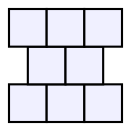
Staggered figure of 8 boxes in three offset rows (3, 2, 3) used to place letters A to E so no row is left empty Intuition: first count all ways to place the 5 distinct letters into any 5 of the 8 boxes with no restriction, then use inclusion–exclusion to subtract off the arrangements that accidentally leave an entire row untouched.
- The staggered figure's 8 boxes split into three rows of sizes 3, 2, and 3 respectively (the offset top/bottom bands and the narrower shared middle band of the stepped, plus-like outline).
- Unrestricted count: choose and arrange the 5 distinct letters A,B,C,D,E into any 5 of the 8 boxes: P(8,5)=8×7×6×5×4=6720.
- A row of size 3 being completely empty forces all 5 letters into the remaining 2+3=5 boxes: P(5,5)=120 ways; this happens for each of the two size-3 rows, contributing 120+120=240. …
- JEE Main 2024Set 2024-01-31-s14 marksQ.The total number of words (with or without meaning) that can be formed out of the letters of the word 'DISTRIBUTION' taken four at a time, is equal to ______.
›Reveal solutionSolution
Split the 4-letter selections by which repetition pattern of the multiset {D,I3,S,T2,R,B,U,O,N} they use, and sum the arrangement counts.
- Letter inventory: I appears 3 times, T appears 2 times, and D,S,R,B,U,O,N appear once each — 9 distinct letters total.
- All 4 distinct: choose 4 of the 9 distinct letters and arrange: (49)×4!=126×24=3024.
- One letter twice, two others distinct (AABC): the doubled letter must be I or T (2 choices); the other two distinct letters come from the remaining 8: (28)=28; arrangements =2!4!=12. Total =2×28×12=672. …
- JEE Main 2024Set 2024-04-08-s14 marksQ.The number of 3-digit numbers, formed using the digits 2, 3, 4, 5 and 7, when the repetition of digits is not allowed, and which are not divisible by 3, is equal to ______.
›Reveal solutionSolution
Count all 3-digit numbers without repetition, then subtract those whose digit sum is divisible by 3 (divisibility rule for 3).
-
Total 3-digit numbers from {2,3,4,5,7} without repetition: 5×4×3=60.
-
A number is divisible by 3 iff the sum of its digits is divisible by 3. List 3-element subsets and their sums:
- {2,3,4}: sum 9 ✓
- {2,3,5}: sum 10 ✗
- {2,3,7}: sum 12 ✓
- {2,4,5}: sum 11 ✗
- {2,4,7}: sum 13 ✗
- {2,5,7}: sum 14 ✗
- {3,4,5}: sum 12 ✓
- {3,4,7}: sum 14 ✗ …
-
- JEE Main 2023Set 2023-01-24-s14 marksMCQQ.The number of integers, greater than 7000, that can be formed using the digits 3, 5, 6, 7, 8 without repetition, is (A) 120 (B) 168 (C) 220 (D) 48
›Reveal solutionSolution
Split by number of digits used: 4-digit numbers need a leading digit of 7 or 8 to exceed 7000, while every 5-digit arrangement of all five digits automatically exceeds 7000.
- 4-digit numbers >7000: leading digit must be 7 or 8 (digits 3,5,6 as leading digit give numbers <7000).
- Leading digit =7: remaining 3 positions filled from {3,5,6,8}: P(4,3)=4×3×2=24 ways.
- Leading digit =8: remaining 3 positions filled from {3,5,6,7}: again 24 ways. …
🎓Unlock everything free for 10 days
- ✓Full step-by-step solutions
- ✓Concept-first explanations
- ✓Methods, shortcuts & mistakes
- ✓PYQ mapping + timed mock tests
Full access for 10 days. No credit card required.