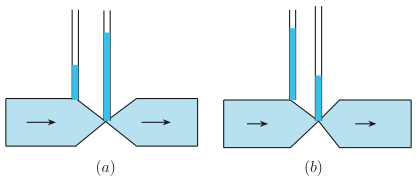
Q.Figures 9.20(a) and
You're viewing a preview — the full solution, concept, methods & PYQ mapping are locked.
Start your 14-day free trial to unlock the full solution →For steady flow through a constriction, the equation of continuity makes the fluid speed largest at the narrow throat, and Bernoulli's principle then makes the pressure smallest there. A vertical side-tube rises to a height set by the local pressure, so the column at the throat must be the SHORTEST. Diagram (b) obeys this; diagram (a) shows the tallest column at the throat and is therefore incorrect.
Concept
Two ideas govern an ideal (non-viscous, incompressible) fluid in steady flow:
- Equation of continuity: . Where the pipe is narrow (small ), the speed is large.
- Bernoulli's principle (same height): . Where the speed is large, the pressure is small.
Why this fixes the tube heights
Each open vertical tube acts as a manometer: the liquid climbs until the static column balances the local pressure in the pipe, so a taller column means a higher local pressure.
Steps
- At the wide section: area large speed small pressure high tall column.
- At the narrow throat: area small speed large pressure low short column.
- Therefore the physically correct picture has the column over the throat SHORTER than the column over the wide part. …
Unlock everything free for 14 days
- Full step-by-step solutions
- Concept-first explanations
- Methods, shortcuts & mistakes
- PYQ mapping + timed mock tests
Full access for 14 days. No credit card required.