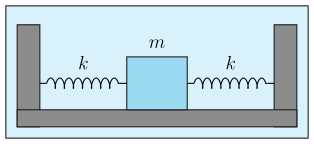
Q.Two identical springs of spring constant are attached to a block of mass and to fixed supports as shown in Fig. 13.14. Show that when the mass is displaced from its equilibrium position on either side, it executes a simple harmonic motion. Find the period of oscillations.
You're viewing a preview — the full solution, concept, methods & PYQ mapping are locked.
Start your 14-day free trial to unlock the full solution →The block is pulled by two springs in parallel, so the effective restoring force is , giving SHM with angular frequency and period .
The key insight is that simple harmonic motion arises whenever the net restoring force on a body is directly proportional to its displacement from equilibrium and acts opposite to that displacement — that is, where is a positive constant. Once you identify that form, the angular frequency is and the period follows immediately.
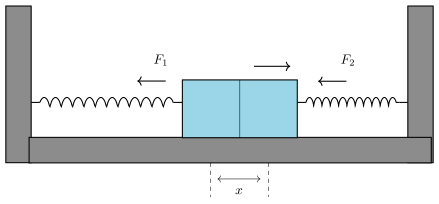
Here, the block is attached between two identical springs. When the block is at the equilibrium position, both springs are at their natural lengths (assuming no initial tension). If you displace the block to the right by a small distance , the right spring gets compressed by and pushes left; the left spring gets stretched by and pulls left. Both forces act in the same direction — toward the equilibrium position.
Let’s work through it step by step.
- Set up the forces.
Take the equilibrium position as , with positive to the right.
- Left spring: stretched by , so it exerts a force (negative means to the left).
- Right spring: compressed by , so it exerts a force as well (also to the left). The net force on the block is the sum:
-
Recognise the SHM condition.
The net force is proportional to displacement () and opposite in direction. This is exactly Hooke’s law with an effective spring constant .
For SHM: , where here.
-
Write the equation of motion.
Using Newton’s second law: …
Unlock everything free for 14 days
- Full step-by-step solutions
- Concept-first explanations
- Methods, shortcuts & mistakes
- PYQ mapping + timed mock tests
Full access for 14 days. No credit card required.