Physical Education · Ch 2 — Children and Women in Sports
Knock Knees
Knock Knees
Meaning and Definition
Knock knee, medically termed Genu Valgum, is a postural deformity of the lower limbs. In a person with this condition, when they stand with their legs straight and feet together, the knees touch or knock against each other while the ankles remain separated by a gap. The normal alignment of the lower limb is such that a straight line drawn from the hip joint through the knee joint should pass through the ankle joint. In knock knee, the knee joint is displaced inward (medially) relative to this line, causing the tibia and fibula to angle outward.
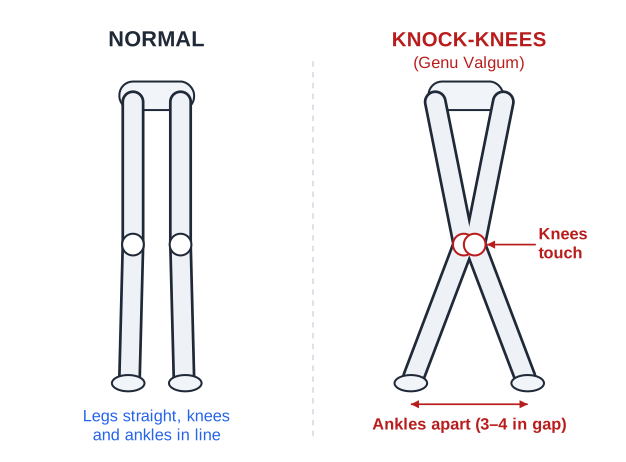
Drawn by us to help you understand the concept clearly, and verified to make sure it's accurate. For exams, practice from your textbook's own diagram.
A front view of the two leg bones. The knees converge and touch in the middle while the lower legs and ankles splay apart, leaving a 3-4 inch gap between the ankles - the defining 'knees together, ankles apart' shape of Knock Knees (Genu Valgum). It i …
The deformity is essentially the opposite of bow legs (Genu Varum). While bow legs create a gap between the knees when the ankles are together, knock knee creates a gap between the ankles when the knees are together. The severity of knock knee is measured by the distance between the two medial malleoli (the bony prominences on the inner side of each ankle) when the knees are held in contact.
The defining feature of knock knee is: knees together, ankles apart. This single observation is the basis for both recognition and testing of the deformity.
Recognition and Testing
The standard clinical test for knock knee is straightforward and can be performed without any equipment.
Procedure:
- The individual stands in a relaxed, upright position with both legs straight and the feet pointing forward.
- The examiner asks the individual to bring the knees together so that the inner surfaces of both knees are touching.
- With the knees held in contact, the examiner observes the position of the ankles.
Interpretation:
- Normal alignment: The ankles touch each other when the knees are together.
- Knock knee: The ankles do not touch. There is a visible gap between the inner ankle bones (medial malleoli). The greater the distance between the ankles, the more severe the deformity.
The distance between the ankles is sometimes measured in centimetres to grade the severity, though for Class 12 purposes, the qualitative observation is sufficient. A gap of more than 7–8 cm between the ankles is generally considered significant.
Do not confuse the test for knock knee with the test for bow legs. In bow legs, the test involves bringing the ankles together and measuring the gap between the knees. In knock knee, the test involves bringing the knees together and measuring the gap between the ankles.
Causes
Knock knee can arise from multiple factors, ranging from normal developmental stages to pathological conditions.
1. Physiological (Normal Development): Many children between the ages of 2 and 6 years naturally develop a mild knock knee appearance. This is part of normal skeletal development and typically corrects itself by age 7–8 without any intervention. The legs progress from bow legs in infancy to knock knee in early childhood, then to straight alignment.
2. Nutritional Deficiencies: The most common pathological cause is rickets, a condition caused by vitamin D deficiency. Vitamin D is essential for calcium absorption and bone mineralization. When deficient, the bones become soft and weak (osteomalacia). The weight of the body then causes the long bones of the legs to bend, leading to knock knee. Calcium deficiency alone can also contribute.
3. Obesity: Excess body weight places increased stress on the knee joints. In growing children, this mechanical overload can cause the medial (inner) side of the knee joint to compress more than the lateral side, gradually pushing the knees inward.
4. Genetic and Congenital Factors: Some children are born with a predisposition to knock knee. Certain genetic conditions, such as skeletal dysplasias, can affect bone growth and alignment.
5. Injury or Infection: Trauma to the growth plate (epiphyseal plate) around the knee, particularly the lateral side of the tibial plateau, can cause uneven growth. If the outer part of the growth plate is damaged, the inner part continues to grow normally, pulling the knee inward. Similarly, infections affecting the growth plate can produce the same effect.
6. Muscle Imbalance: Weakness in certain muscle groups, particularly the hip abductors and external rotators, can alter the alignment of the lower limb. Tightness in the iliotibial (IT) band can also contribute.
Problems Created for Movement and Sport
Knock knee is not merely a cosmetic concern. It creates functional problems that affect movement efficiency and increase injury risk, particularly in sports.
1. Abnormal Gait Pattern: The individual walks with the knees rubbing together. The feet are often pronated (rolled inward) to compensate for the ankle gap. This inefficient gait pattern wastes energy and reduces walking and running speed.
2. Knee Pain and Instability: The abnormal alignment places excessive stress on the lateral (outer) side of the knee joint. The medial collateral ligament (MCL) is stretched, and the lateral meniscus is compressed. Over time, this leads to chronic knee pain, particularly on the outer side of the knee, and can predispose the individual to ligament injuries and early-onset osteoarthritis.
3. Increased Risk of Ankle and Foot Injuries: The compensatory foot pronation places the ankle in a vulnerable position. Ankle sprains, particularly inversion sprains, become more common. Flat feet (pes planus) often develop as a secondary problem.
4. Reduced Athletic Performance: The misalignment reduces the efficiency of force transmission from the ground through the legs. Jumping height, sprint speed, and agility are all compromised. The individual cannot generate power as effectively because the knee is not tracking in its optimal mechanical plane.
5. Hip and Lower Back Problems: The altered lower limb mechanics can radiate upward. The hips may rotate abnormally, and the pelvis may tilt, leading to hip pain and lower back strain during prolonged standing, walking, or running.
In sports that involve running, jumping, and cutting (basketball, football, volleyball), knock knee significantly increases the risk of anterior cruciate ligament (ACL) injuries. The inward collapse of the knee is a classic mechanism for non-contact ACL tears.
Corrective Measures
The approach to correction depends on the severity, the age of the individual, and the underlying cause. For mild cases, especially in young children, observation alone may be sufficient as the condition corrects with growth. For moderate to severe cases, intervention is needed.
1. Nutritional Correction: If the cause is rickets or calcium deficiency, the primary treatment is dietary. Vitamin D supplementation, increased sun exposure, and a diet rich in calcium (milk, dairy products, green leafy vegetables) are essential. Once the bones are properly mineralized, further deformity is prevented, and mild cases may gradually improve.
2. Orthotic Devices: In growing children, specially designed shoes with wedges on the inner side of the sole (medial heel wedges) can help realign the lower limb. Night braces that hold the legs in a corrected position may also be used in severe cases.
3. Surgical Intervention: For severe, persistent knock knee in adolescents or adults that does not respond to conservative treatment, surgery may be considered. The most common procedure is an osteotomy — cutting the tibia or femur and realigning it in a straighter position, held in place with plates and screws. This is a major surgery with a significant recovery period.
4. Corrective Exercises: This is the most relevant category for Physical Education. Specific exercises aim to strengthen the muscles that pull the knee outward and stretch the muscles that pull it inward.
Corrective Exercises
Each exercise works through a specific mechanical principle to counteract the deformity.
Horse Riding
Horse riding is considered one of the most effective natural corrective activities for knock knee.
How it works: When riding a horse, the individual must grip the horse's body with the inner thighs and knees to maintain balance. This action requires the rider to press the knees inward against the horse's sides. However, the key is that the horse's broad back forces the knees apart into a more abducted (outward) position. The rider must actively work to keep the knees in contact with the horse, which strengthens the adductor muscles of the thigh while simultaneously stretching the lateral structures of the knee. The rhythmic motion of the horse also promotes normal joint movement.
Execution: Regular horse riding sessions, even 20–30 minutes a day, can produce noticeable improvement over several months. For those without access to a horse, the same motion can be simulated by sitting on a large exercise ball or a rolled-up mat and squeezing the thighs together.
Keeping a Pillow Between the Knees and Pressing the Knees Together
This is a simple, home-based isometric exercise.
How it works: The individual places a firm pillow or a rolled-up towel between the knees while lying on the back with legs straight. They then press the knees together as hard as possible, squeezing the pillow. This action contracts the adductor muscles of the thigh (the muscles that pull the legs together). While this may seem counterintuitive (it pulls the knees together, which is the deformity), the purpose is different. The pillow maintains a gap between the knees, so the squeezing action actually works against the tendency of the knees to drift further apart. More importantly, this exercise strengthens the muscles that stabilize the knee joint in a neutral position. When performed correctly, it also engages the core and gluteal muscles.
Execution: Hold the squeeze for 10–15 seconds, then relax. Repeat 10–15 times, for 2–3 sets daily.
A variation of this exercise can be done while standing. Stand with a pillow between the knees and perform a partial squat while maintaining the squeeze. This adds weight-bearing and functional training to the exercise.
Padmasana (Lotus Pose)
Padmasana is a seated yoga posture that helps correct knock knee by stretching the tight lateral structures and improving hip flexibility.
How it works: In Padmasana, the feet are placed on the opposite thighs, which externally rotates the hips and opens the knee joints. This position creates a gentle stretch along the outer side of the knees and thighs. For a person with knock knee, the lateral structures (IT band, lateral collateral ligament) are often tight and shortened. Padmasana helps lengthen these structures, allowing the knee to track more normally. The pose also strengthens the muscles around the hip joint, which are crucial for lower limb alignment.
Execution: Sit on the floor with legs extended. Bend the right knee and place the right foot on the left thigh, as high up as possible. Bend the left knee and place the left foot on the right thigh. Rest the hands on the knees. Hold the pose for 30–60 seconds, then repeat with the opposite leg placement. Beginners may find it difficult to achieve the full pose and can start with half Padmasana (one foot on the opposite thigh).
Padmasana should be performed gently and without force. If there is sharp pain in the knee, the pose should be modified or avoided. Never force the foot onto the thigh — this can injure the knee joint.
Gomukhasana (Cow Face Pose)
Gomukhasana is another yoga posture that is highly effective for knock knee correction.
How it works: In Gomukhasana, the knees are stacked one on top of the other, with the feet placed on either side of the hips. This position creates a strong stretch along the outer hips and thighs (the gluteal muscles and IT band). For knock knee, the hip abductors and external rotators are often tight, pulling the knees inward. Gomukhasana stretches these muscles, allowing the femur to sit more neutrally in the hip socket. The pose also opens the chest and shoulders, but the primary benefit for knock knee is the hip and thigh stretch. …