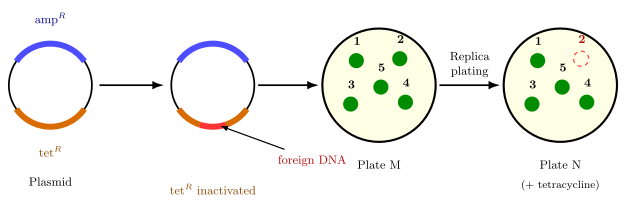
Q.Study the diagram given below that shows the steps involved in the procedure of selecting transformed bacteria and answer the questions that follow:
You're viewing a preview — the full solution, concept, methods & PYQ mapping are locked.
Start your 14-day free trial to unlock the full solution →Part (a): the transformed recombinant grows on ampicillin but not tetracycline (insertional inactivation of the tetracycline gene); insertion points are restriction/cloning sites, resistance genes are selectable markers; the two enzymes are restriction endonuclease and DNA ligase.
Part (c): β-galactosidase (from lacZ) is the reporter — recombinants (insert in lacZ) lose the enzyme and stay white, non-recombinants turn blue.
The diagram shows selection of transformed bacteria by insertional inactivation. The original plasmid carries genes for ampicillin resistance and tetracycline resistance. Foreign DNA is inserted into the tetracycline-resistance gene, disrupting it, so a recombinant plasmid confers ampicillin resistance only.
Part (a)
- Identifying the transformed colony. Colonies are first grown on Plate M, then replica-plated onto Plate N containing both antibiotics. The transformed (recombinant) colony is the one that grows on Plate M / ampicillin but does NOT grow on Plate N with tetracycline. Justification: it possesses the plasmid (hence ampicillin resistance and growth on M), but the inserted foreign DNA has inactivated its tetracycline-resistance gene, so it cannot survive on tetracycline. Colonies that grow on both antibiotics carry the original, non-recombinant plasmid.
- The sites and their role. The specific plasmid positions where the antibiotic-resistance genes lie and where foreign DNA is inserted are recognition sites / restriction (cloning) sites — short, specific sequences cut by restriction enzymes. Their roles in genetic engineering are twofold: (i) they are the precise points at which restriction endonucleases open the vector so foreign DNA can be spliced in; and (ii) the resistance genes serve as selectable markers — allowing transformed cells to be selected on antibiotic media and, through insertional inactivation of one marker, recombinants to be distinguished from non-recombinants. …
Unlock everything free for 14 days
- Full step-by-step solutions
- Concept-first explanations
- Methods, shortcuts & mistakes
- PYQ mapping + timed mock tests
Full access for 14 days. No credit card required.