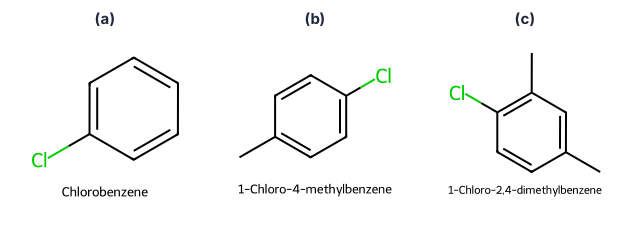
Q.Arrange the compounds in increasing order of rate of reaction towards nucleophilic substitution. (Note printed in the Exemplar for questions 26 to 29.)
You're viewing a preview — the full solution, concept, methods & PYQ mapping are locked.
Start your 14-day free trial to unlock the full solution →
Nucleophilic aromatic substitution (SNAr) goes through a negatively charged Meisenheimer intermediate, so it needs the OPPOSITE kind of substituent that speeds up electrophilic aromatic substitution: electron-WITHDRAWING groups stabilise that negative charge and speed SNAr up, while electron-DONATING groups (like methyl) destabilise it and slow SNAr down. More methyl groups at activating (ortho/para) positions means a slower reaction, not a faster one. The correct increasing-rate order is 1-chloro-2,4-dimethylbenzene < 1-chloro-4-methylbenzene < chlorobenzene, i.e. (c) < (b) < (a), option (iii).
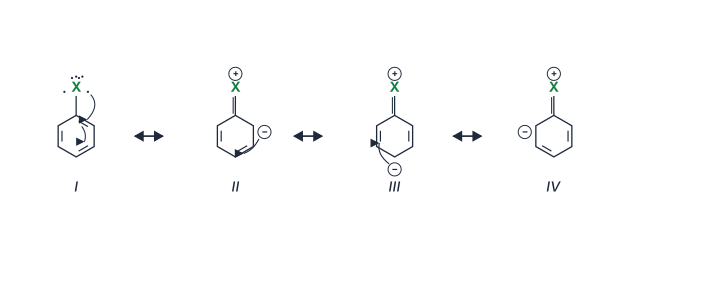
Why the Meisenheimer complex direction matters
SNAr does not follow SN1/SN2 logic. The nucleophile adds to the ring FIRST, at the carbon bearing the halogen, building a negatively charged intermediate (the Meisenheimer complex) before the halide ever leaves. Whatever stabilises that negative charge speeds up the rate-determining step; whatever destabilises it slows the reaction down.
A methyl group is electron-donating (+I effect and hyperconjugation). Donating extra electron density INTO a ring that is already trying to hold a negative charge makes that charge less stable, not more — the ring becomes reluctant to accept even more electron density from the incoming nucleophile. So methyl groups at the ortho/para positions (the positions where the Meisenheimer complex's negative charge is actually delocalised) slow SNAr down. This is the reverse of electrophilic aromatic substitution, where a methyl group speeds the reaction up by stabilising a positively charged intermediate — SNAr and EAS intermediates carry opposite charges, so the same substituent has opposite effects.
Working through the three compounds
- (a) Chlorobenzene — no substituents at all, so nothing works against the Meisenheimer complex forming. This is the fastest. …
Unlock everything free for 14 days
- Full step-by-step solutions
- Concept-first explanations
- Methods, shortcuts & mistakes
- PYQ mapping + timed mock tests
Full access for 14 days. No credit card required.