Q.Assertion: Presence of a nitro group at ortho or para position increases the reactivity of haloarenes towards nucleophilic substitution.
Reason: Nitro group, being an electron withdrawing group decreases the electron density over the benzene ring.
You're viewing a preview — the full solution, concept, methods & PYQ mapping are locked.
Start your 14-day free trial to unlock the full solution →A nitro group at the ortho or para position genuinely does increase the reactivity of a haloarene towards nucleophilic substitution, and it does so precisely because it is a strong electron-withdrawing group that pulls electron density off the ring — that withdrawal is what stabilises the negatively-charged Meisenheimer intermediate the reaction goes through. Both statements are correct, and the reason correctly explains the assertion. The correct option is (i).
Why haloarenes are normally slow to undergo nucleophilic substitution
In an ordinary haloarene like chlorobenzene, the ring is electron-rich (helped along by the halogen's own lone-pair donation into the ring), so an incoming nucleophile finds the ring carbon unattractive to attack. Harsh conditions are usually needed.
What a nitro group changes
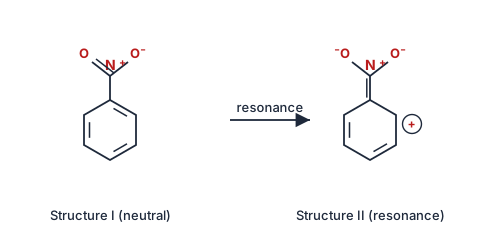
A nitro group is a powerful electron-withdrawing group, both through induction and through resonance. As the diagram shows, the ring's own electrons can shift toward the nitro group, leaving a formal positive charge on the ring carbon and extra negative charge on a nitro oxygen. This withdrawal lowers the electron density on the ring overall — the exact statement the reason makes.
Why that withdrawal is the correct explanation …
Unlock everything free for 14 days
- Full step-by-step solutions
- Concept-first explanations
- Methods, shortcuts & mistakes
- PYQ mapping + timed mock tests
Full access for 14 days. No credit card required.