Mathematics · Ch 10 — Vector Algebra
Projection of a Vector on a Line
Projection of a Vector on a Line
10.6.2 Projection of a Vector on a Line
The Core Idea
When a vector makes an angle with a directed line (measured anticlockwise), the projection vector of on is a vector whose magnitude is , with the same direction as when and opposite when . Its magnitude is called the projection of on .
The textbook uses "projection" for the scalar (signed) magnitude, and "projection vector" for the full vector carrying both magnitude and direction.
Observations and Key Results
Observation 1: Projection Using a Unit Vector
If is the unit vector along a line , the projection of on is:
because , the signed magnitude of the projection.
Observation 2: Projection of One Vector on Another
The projection of on another vector is:
where is the unit vector in the direction of .
Projection of on
Observation 3: Special Angles
- If , then , so the projection vector of is itself.
- If , then , so the projection vector of is (opposite direction).
Observation 4: Perpendicular Case
If or , then , so the projection vector of is the zero vector.
Direction Cosines and Projections on Axes
If , , are the direction angles of , its direction cosines are: …
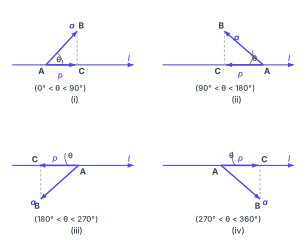
Drawn by us to help you understand the concept clearly, and verified to make sure it's accurate. For exams, practice from your textbook's own diagram.
The figure is a set of four panels, labelled (i) through (iv), each showing the same basic geometry: a horizontal directed line (with an arrowhead indicating its positive direction), a vector starting from a point on , and a dashed perpendicular dropped from to meet at a foot . The segment along is the projection vector .
What changes from panel to panel is the angle that makes with , measured anticlockwise from to the vector. The four panels cover the four quadrants of the angle:
- (i) — the projection points to the right (same direction as ).
- (ii) — the projection points to the left (opposite to ).
- (iii) — again points left.
- (iv) — points right, and here lies below the line .
The core idea is that the projection of a vector onto a directed line is itself a vector — its magnitude is , and its direction is the same as when and opposite when . The sign of alone decides the direction of the projection vector along .
where is the unit vector along . The scalar is called the projection (a signed scalar), and its absolute value is the length of the projection vector.
The figure makes this sign convention visual: in panels (i) and (iv), is positive, so the projection vector points rightward along ; in (ii) and (iii), is negative, so it points leftward. The dashed perpendicular from to is the geometric construction that gives — the signed length of the projection.
A common mistake is to think the projection is always the length of the shadow on the line. The projection vector has a direction: it points along if the angle is acute, and opposite to if the angle is obtuse. The scalar projection can be negative; the magnitude is the length. …