Q.A battery of and negligible internal resistance is connected across the diagonally opposite corners of a cubical network consisting of 12 resistors each of resistance (Fig. 3.16). Determine the equivalent resistance of the network and the current along each edge of the cube.
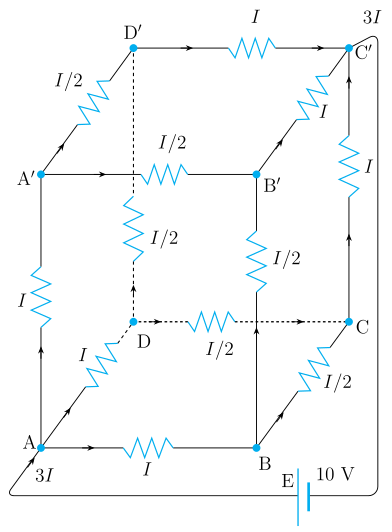
Using the three-fold symmetry of a cube fed across its body diagonal, the twelve edges reduce to ; the cell drives , giving in each of the six edges at the two corners and in each of the six middle edges.
Setting up the symmetry. The battery is across the body diagonal, from corner (entry) to the opposite corner (exit). Three edges leave ; by symmetry they are indistinguishable, so the total current splits equally: in each. Each such edge ends on a vertex adjacent to ; from there two edges continue toward , so by symmetry the splits into in each of these six 'middle' edges. Finally three edges arrive at , each carrying (pairs of middle edges of merging).
Potential drop along a diagonal path. Follow (adjacent middle exit):
Equivalent resistance. This drop equals the battery voltage, , and by definition , so
Total and branch currents.
- Three edges at and three at : each.
- Six middle edges: each.
; total current . Current in each of the six edges meeting the entry and exit corners, and in each of the six middle edges.
Unlock everything free for 14 days
- Full step-by-step solutions
- Concept-first explanations
- Methods, shortcuts & mistakes
- PYQ mapping + timed mock tests
Full access for 14 days. No credit card required.