Q.Given three resistors of resistances 1 Ω (Ohm), 2 Ω (Ohm) and 3Ω (Ohm). How will you combine them to get an equivalent resistance of 11/5 Ω (Ohm) ?
🔒You're viewing a preview — the full solution, concept, methods & PYQ mapping are locked.
🔒 Start your 14-day free trial to unlock the full solution →Concept understanding — Series and Parallel Combination of Resistors
When resistors are connected end-to-end along a SINGLE path (series), exactly the same current flows through every one of them, while the supply voltage divides UNEQUALLY between them in proportion to each resistor's own value. This gives the SERIES equivalent-resistance rule: the equivalent resistance is simply the SUM of the individual resistances, Rs=R1+R2+⋯+Rn -- always LARGER than the largest individual resistor in the group.
When resistors are instead connected between the SAME pair of points (parallel), each resistor forms its own independent path carrying its own share of the total current, while the SAME voltage appears across every one of them. This gives the PARALLEL equivalent-resistance rule: the RECIPROCAL of the equivalent resistance equals the sum of the reciprocals of the individual resistances, 1/Rp=1/R1+1/R2+⋯+1/Rn -- always SMALLER than the smallest individual res …
The target eleven-fifths of an ohm is just 2.2 ohm, which is 1 ohm added to 1.2 ohm, and 1.2 ohm is exactly the parallel value of the 2 ohm and 3 ohm resistors. …
Put the 2 Ω and 3 Ω resistors in parallel (giving 1.2 Ω) and add the 1 Ω resistor in series with that combination to get 11/5 Ω.
We need Req=511 Ω=2.2 Ω.
First, combine the 2 Ω and 3 Ω resistors in parallel:
Rp1=21+31=63+2=65⟹Rp=56=1.2 Ω
Now add the 1 Ω resistor in series with this parallel combination:
Req=1+Rp=1+56=55+6=511 Ω
…
Showing the 12 most recent of 16 on this concept.
- CBSE 2026Set A1 markMCQQ.The equivalent resistance of resistors in parallel combination (A) decreases (B) increases (C) remains same (D) none of these
›Reveal solutionSolution
Adding resistors in parallel opens up more current paths, so the equivalent resistance falls below the smallest branch resistance.
For resistors in parallel the reciprocals add:
Req1=R11+R21+⋯
…
- CBSE 2026Set ANNUAL1 markMCQQ.There are n resistors each of resistance R. When they are connected in parallel, the equivalent resistance is x. If they are connected in series, the equivalent resistance will be(a) x/n^2(b) n^2 x(c) x/n(d) nx
›Reveal solutionSolution
If n equal resistors R give parallel resistance x, their series resistance is n2x.
For n identical resistors, each of resistance R, connected in parallel: …
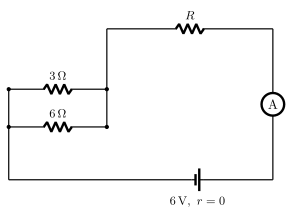
- CBSE 2026Set ANNUAL1 markMCQQ.If the ammeter in the given circuit reads 2 amperes, the resistance R is(a) 1 ohm(b) 2 ohms(c) 3 ohms(d) 4 ohms
›Reveal solutionSolution
The 3 Ω and 6 Ω resistors in parallel give 2 Ω; using the total emf and ammeter current gives R=1 Ω.
The 3 Ω and 6 Ω resistors are in parallel:
Rp=3+63×6=918=2 Ω
…
- CBSE 2026Set ANNUAL1 markMCQQ.If a uniform wire of resistance 16 ohm is cut into four equal parts and attached in parallel combination, the equivalent resistance of the combination is(a) 1 ohm(b) 4 ohm(c) 1/4 ohm(d) 1/16 ohm
›Reveal solutionSolution
Cutting a uniform wire into N equal pieces divides each piece's resistance by N; connecting those pieces in parallel divides the equivalent resistance by N again.
Resistance of a uniform wire is proportional to its length: R = rho*l/A. If a wire of resistance R = 16 ohm is cut into 4 EQUAL parts, each part is 1/4 the original length, so each part has resistance
r = R/4 = 16/4 = 4 ohm
…
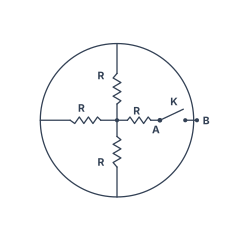
- CBSE 2025Set 55/5/11 markMCQQ.Four resistors, each of resistance R, and a key K are connected as shown in the figure. The equivalent resistance between points A and B when key K is open will be: (A) 4R (B) ∞ (C) 4R (D) 34R
›Reveal solutionSolution
When key K is open, the circuit reduces to a single resistor R from A to the central node O, followed by three resistors R in parallel from O to the ring (which is all one node including B). The equivalent resistance is R+3R=34R.
Figure — 55/5/1 Q3 The key insight here is that the conducting ring is a perfect conductor — it has zero resistance. That means every point on the ring is at the same electrical potential. So the top (T), bottom (Bot), left (L), and terminal B are all the same node. This is the heart of the problem.
When K is open, the branch containing K carries no current — it's just an open circuit. So current from A can only go through the resistor R to the central node O. From O, there are three paths: through the three resistors R to T, Bot, and L — but all three of those points are connected to the ring, which is node B. So those three resistors are in parallel between O and B.
Let's work through it step by step.
-
Identify the nodes with the ring closed.
The ring is a zero-resistance wire. Points T, Bot, L, and B are all shorted together. So they form a single electrical node — call it node B for convenience.
-
Trace the path from A to B with K open.
Starting at A, the only way to reach B is:
A → resistor R → central node O → then through any of the three resistors R to the ring (node B).
The K branch is open, so no current flows through it.
-
Find the equivalent resistance from O to B.
From O, three resistors R each go to the ring (node B). Since all three share the same two nodes (O and B), they are in parallel.
The parallel combination of three equal resistors R is:
Rparallel=3R …
-
- CBSE 2025Set D1 markMCQQ.In series circuit with resistors R1, R2 and R3, the current flowing through each resistor is (A) same (B) different (C) zero (D) divided proportionally to the value of resistance
›Reveal solutionSolution
Current is the same through all resistors in series.
In a series combination the resistors form a single unbranched path, so charge has nowhere else to go — the same current I flows through R₁, R₂ and R₃. What differs is the voltage drop across each (V₁ = IR₁, e …
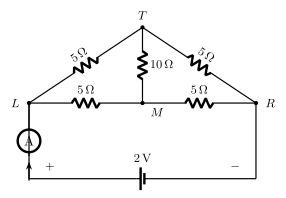
- CBSE 2025Set ANNUAL1 markMCQQ.The ammeter reading in the adjoining circuit is(a) 1/5 A(b) 2/5 A(c) 3/5 A(d) 4/5 A
›Reveal solutionSolution
This is a balanced Wheatstone-bridge-shaped network: the 10-ohm arm carries no current, so the circuit reduces to two equal 10-ohm paths in parallel; the ammeter (in one arm) reads half the total current.
Label the left corner node L, right corner node R (battery terminals), top node T, and middle node M.
- Path 1 (upper): L → T → R, resistances 5 Ω + 5 Ω = 10 Ω
- Path 2 (lower): L → M → R, resistances 5 Ω + 5 Ω = 10 Ω
- Bridge element: T → M, 10 Ω
Check the Wheatstone-bridge balance condition on the two arms meeting at L and R: RTRRLT=55=1 and RMRRLM=55=1 — equal ratios, so the bridge is balanced and no current flows through the 10 Ω bridge arm (T-M).
With the bridge arm carrying no current, the network is simply two 10 Ω paths (L-T-R and L-M-R) in parallel between the battery terminals:
…
- CBSE 2024Set A1 markMCQQ.n equal resistors are first connected in series and then in parallel. The ratio of maximum and minimum resistances will be (A) 1/n (B) n (C) 1/n^2 (D) n^2
›Reveal solutionSolution
R_series = nR (maximum), R_parallel = R/n (minimum) → ratio = nR ÷ (R/n) = n².
For n equal resistors each of resistance R:
- Series (maximum): Rmax=nR. …
- CBSE 2021Set A1 markMCQQ.Which of the following is the same in parallel connection of resistances? (A) Potential difference (B) Current (C) Both Potential difference and current (D) None of these
›Reveal solutionSolution
In a parallel combination the potential difference across each resistor is the same; the current divides.
When resistors are connected in parallel, both ends of every resistor are joined to the same pair of nodes. Therefore each resistor has the same potential difference V across it.
…
- CBSE 2020Set XS1 markMCQQ.A wire of 24 ohm resistance is bent in the form of an equilateral triangle. The effective resistance between any two corners is:(i) 29 ohm(ii) 316 ohm(iii) 12 ohm(iv) 24 ohm
›Reveal solutionSolution
Three 8 Ω sides; one side is parallel to the other two in series ⇒316Ω.
Set-up. A 24 Ω wire bent into an equilateral triangle gives three equal sides of 24/3=8Ω each.
Between two corners. Current has two paths:
- the direct side: 8Ω
- the other two sides in series: 8+8=16Ω …
- CBSE 2020Set ANNUAL1 markMCQQ.If a uniform wire of resistance 16 ohm is cut into four equal parts and attached in parallel combination, the equivalent resistance is(a) 1 ohm(b) 4 ohm(c) 1/4 ohm(d) 1/16 ohm
›Reveal solutionSolution
Cutting a wire into n equal parts divides its resistance by n; reconnecting those n parts in parallel divides the resulting resistance by n again, so the net effect is R divided by n squared.
A uniform wire's resistance is R = (rho L)/A. Cutting it into 4 equal-length parts gives each part a resistance of 16/4 = 4 ohm (since resistance is proportional to length, for the same wire material and cross-section). …
- CBSE 2020Set OC1 markMCQQ.The total resistance of two resistors when connected in series is 9 Ω and when connected in parallel is 2 Ω. The values of two resistances are(a) 4 Ω and 5 Ω(b) 2 Ω and 7 Ω(c) 3 Ω and 6 Ω(d) 1 Ω and 8 Ω
›Reveal solutionSolution
Series sum and parallel product-over-sum give two equations in the two unknown resistances, solvable as a quadratic.
Step 1 — Two equations
R1+R2=9R1+R2R1R2=2⟹R1R2=18
Step 2 — Quadratic in x=R1 (with R2=9−x)
x(9−x)=18⟹x2−9x+18=0
…
🎓Unlock everything free for 14 days
- ✓Full step-by-step solutions
- ✓Concept-first explanations
- ✓Methods, shortcuts & mistakes
- ✓PYQ mapping + timed mock tests
Full access for 14 days. No credit card required.