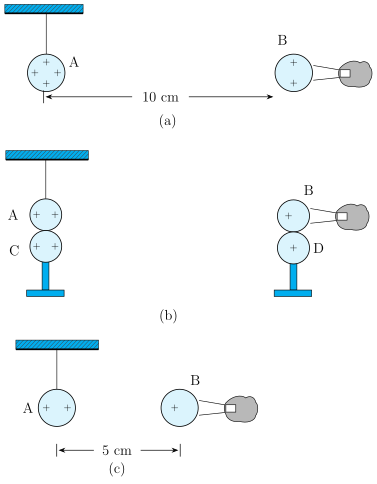
Q.A charged metallic sphere A is suspended by a nylon thread. Another charged metallic sphere B held by an insulating handle is brought close to A such that the distance between their centres is , as shown in Fig. 1.4(a). The resulting repulsion of A is noted (for example, by shining a beam of light and measuring the deflection of its shadow on a screen). Spheres A and B are touched by uncharged spheres C and D respectively, as shown in Fig. 1.4(b). C and D are then removed and B is brought closer to A to a distance of between their centres, as shown in Fig. 1.4(c).
You're viewing a preview — the full solution, concept, methods & PYQ mapping are locked.
Start your 14-day free trial to unlock the full solution →When identical conducting spheres touch, they share charge equally. After halving both charges and halving the distance, the inverse-square law predicts the repulsion remains unchanged.
The heart of this problem is understanding how charge redistributes when conductors touch, then applying Coulomb's law to compare forces at different configurations.
When two identical conducting spheres touch, they reach the same potential — which for identical spheres means they share the total charge equally. If sphere A carries charge and touches an uncharged identical sphere C, each ends up with . The same happens to B and D.
Coulomb's law tells us the electrostatic force between two point charges (or spherically symmetric charge distributions) is
where and is the centre-to-centre separation. The force scales as the product of charges and inversely as the square of distance.
Step-by-step comparison
-
Initial configuration (a): distance , original charges
Let the initial charges be and . The repulsive force is
-
Charge redistribution (b): touching with uncharged spheres
- Sphere A touches uncharged sphere C (identical size). Total charge splits equally: each gets .
- Sphere B touches uncharged sphere D. Total charge splits equally: each gets .
After C and D are removed, A carries and B carries .
-
Final configuration (c): distance , halved charges
The new force is
- Comparison …
Unlock everything free for 14 days
- Full step-by-step solutions
- Concept-first explanations
- Methods, shortcuts & mistakes
- PYQ mapping + timed mock tests
Full access for 14 days. No credit card required.