Q.Consider three charges , , each equal to at the vertices of an equilateral triangle of side . What is the force on a charge (with the same sign as ) placed at the centroid of the triangle?
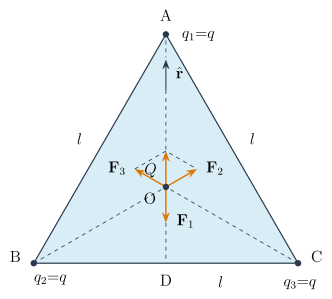
The three equal repulsive forces on from the three vertices are equal in magnitude and spaced apart, so their vector sum is zero. The net force on is .
The key idea is Coulomb’s law with superposition. Each vertex charge exerts a repulsive force on (since both have the same sign). Because the triangle is equilateral, the centroid is equidistant from all three vertices, so each force has the same magnitude. And because the three vertices are symmetrically placed around the centroid, the three force vectors point along the medians, apart. When three equal vectors are arranged at intervals, they cancel exactly.
Let’s work through it step by step.
- Distance from centroid to each vertex. In an equilateral triangle of side , the centroid is also the circumcenter. The distance from the centroid to any vertex is the circumradius:
(Derivation: the altitude is , and the centroid divides each median in the ratio , so the distance from centroid to vertex is of the altitude: .)
- Magnitude of each force. By Coulomb’s law, the force on due to a single vertex charge is
Since and have the same sign, the force is repulsive — it points directly away from that vertex.
-
Direction of each force.
The centroid lies at the intersection of the medians. The line from a vertex to the centroid is exactly along the median. So the force from vertex points from away from (straight down in the textbook figure), from away from (up-right), and from away from (up-left). These three directions are separated by .
-
Vector addition.
Place the three force vectors tail-to-tail at . They have equal magnitude and are spaced apart. Their resultant is zero.
TipA quick way to see this: the sum of three equal vectors at is zero because they form the sides of an equilateral triangle when placed head-to-tail. Alternatively, resolve each into components: the horizontal components cancel pairwise, and the vertical components also sum to zero.
Explicitly, take the direction from toward as the negative -axis. Then:
Adding:
A common mistake is to think the forces cancel only if is at the center of the triangle — but that’s exactly the centroid. Another pitfall: forgetting that the forces are repulsive and pointing away from the vertices, not toward them. If you mistakenly draw them pointing inward, they’d add to a nonzero resultant.
The net force on is zero: .
Unlock everything free for 14 days
- Full step-by-step solutions
- Concept-first explanations
- Methods, shortcuts & mistakes
- PYQ mapping + timed mock tests
Full access for 14 days. No credit card required.