Physics · Ch 5 — Magnetism and Matter
Diamagnetism
Diamagnetism
What is Diamagnetism?
Diamagnetism is a fundamental magnetic property of matter. A diamagnetic substance, when placed in an external magnetic field, develops a net magnetic moment in the direction opposite to the applied field. This results in a repulsive force: the substance tends to move from a stronger part of the field to a weaker part.
- In a non-uniform field, a diamagnetic bar is repelled away from the region of high field.
- The effect is extremely weak — in most materials, the reduction of the field inside the substance is only about one part in .
- Diamagnetism is present in all substances, but it is often masked by stronger effects like paramagnetism or ferromagnetism.
Physical Explanation: Orbital Electrons and Lenz’s Law
The explanation comes from the behaviour of electrons in atoms.
- Orbital magnetic moment: Electrons orbiting the nucleus behave like tiny current loops. Each such loop possesses an orbital magnetic moment.
- Zero net moment in atoms: In diamagnetic materials, the atoms have no net magnetic moment in the absence of an external field. The magnetic moments of different electrons cancel out.
- Effect of an applied field: When an external magnetic field is applied, it interacts with the orbiting electrons. According to Lenz’s law (studied in Chapter 6), the change in magnetic flux through the electron’s orbit induces an electromotive force. This causes:
- Electrons whose orbital magnetic moment is parallel to to slow down.
- Electrons whose orbital magnetic moment is antiparallel to to speed up.
- Net induced moment: This change in orbital speeds creates a net induced magnetic moment in the direction opposite to the applied field . This is why the substance is repelled.
Examples of Diamagnetic Materials
- Common diamagnets: Bismuth, copper, lead, silicon, nitrogen (at STP), water, sodium chloride.
- Superconductors: The most exotic diamagnetic materials.
Superconductors and Perfect Diamagnetism
Superconductors are metals cooled to very low temperatures. They exhibit two remarkable properties:
- Perfect conductivity: Zero electrical resistance. …
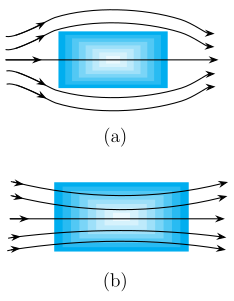
Drawn by us to help you understand the concept clearly, and verified to make sure it's accurate. For exams, practice from your textbook's own diagram.
What the Figure Shows
The figure has two panels, (a) and (b), each showing a horizontal shaded block (the material) placed in a uniform external magnetic field. The external field is represented by evenly spaced horizontal lines with right-pointing arrowheads, indicating a constant field direction from left to right.
-
Panel (a) – Diamagnetic substance: The field lines bow outward around the block. They curve away from the material, splaying apart above and below it. Fewer lines pass through the block compared to the surrounding region. This visualises that the magnetic field inside the diamagnetic material is reduced — the lines are repelled or expelled.
-
Panel (b) – Paramagnetic substance: The field lines bend inward and crowd through the block. They converge into the bar, so more lines pass through it than outside. This shows that the magnetic field inside the paramagnetic material is enhanced — the lines are attracted into the substance.
Physical Idea Taught
The figure illustrates how different materials respond to an external magnetic field at the macroscopic level. The behaviour of field lines directly reflects the material's magnetic properties:
-
Diamagnetism: The material develops a net magnetic moment opposite to the applied field, causing repulsion. The field inside is weaker than outside. This is a universal but weak effect, present in all substances, and arises from induced currents in electron orbits (Lenz’s law).
-
Paramagnetism: The material develops a net magnetic moment aligned with the applied field, causing attraction. The field inside is stronger than outside. This occurs in atoms with permanent magnetic moments (unpaired electrons) that align partially with the field.
Key Formula Developed from This Figure
The textbook uses this figure to introduce the magnetic susceptibility and relative permeability , which quantify the material’s response:
where:
- is the magnetic field inside the material (the net field after the material’s response).
- is the magnetising field (the external applied field, assumed uniform).
- is the permeability of free space ().
- is the relative permeability of the material.
- is the magnetic susceptibility, defined by , where is the magnetisation (magnetic moment per unit volume).
For the two cases in the figure:
- Diamagnetic: is small and negative (e.g., ), so and inside is slightly less than . …