Physics · Ch 5 — Magnetism and Matter
Ferromagnetism
Ferromagnetism
Ferromagnetism: The Strongest Magnetic Response
Ferromagnetic materials are the most familiar magnetic substances—think of iron, cobalt, nickel, and their alloys. They exhibit a very strong attraction to magnets and can become permanently magnetized.
Why Are Ferromagnets So Strong?
The key lies in domains. Unlike paramagnetic atoms that act independently, atoms in a ferromagnet cooperate. Within a small region called a domain (typically ~1 mm in size, containing about atoms), all atomic dipole moments spontaneously align in the same direction. This alignment is a quantum-mechanical cooperative effect.
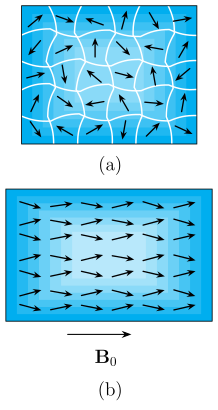
- Without an external field: The domains are randomly oriented. Their magnetizations cancel out, so the bulk material has no net magnetization.
- With an external field : Two things happen:
- Domains that are already aligned with grow in size.
- Other domains rotate to align with . Eventually, the domains merge into a single "giant" domain, producing a very strong net magnetization.
This domain motion is not theoretical—it can be observed under a microscope using a suspension of fine ferromagnetic powder.
Hard vs. Soft Ferromagnets
The behavior after the external field is removed divides ferromagnets into two classes:
- Hard ferromagnets (permanent magnets): Magnetization persists after the field is removed. Examples: Alnico (an alloy of Al, Ni, Co, Cu, Fe) and natural lodestone. These are used for compass needles. …
Drawn by us to help you understand the concept clearly, and verified to make sure it's accurate. For exams, practice from your textbook's own diagram.
What the Figure Shows
The figure consists of two square blocks stacked vertically, each representing a microscopic cross-section of a ferromagnetic material. The blocks are subdivided into irregular, curved cells — these are magnetic domains. Each domain contains a short arrow that indicates the direction of its net magnetic moment.
-
Panel (a) — Randomly Oriented Domains: The arrows inside each domain point in scattered, random directions. Because the orientations are disordered, the vector sum of all domain moments is nearly zero. This corresponds to the unmagnetised state of the material: no net bulk magnetisation ().
-
Panel (b) — Aligned Domains: Every arrow points uniformly to the right. The domains have merged into a single giant domain. Below the block, a bold arrow labelled points right, representing the applied external magnetic field that caused this alignment. The material now has a large net magnetisation in the direction of .
Physical Idea Taught
The figure illustrates the domain theory of ferromagnetism. In a ferromagnetic substance, atoms have permanent magnetic moments that spontaneously align over macroscopic regions called domains (each mm, containing atoms). Without an external field, domains are randomly oriented, giving zero net magnetisation. When an external field is applied, domains that are already aligned with the field grow in size (by wall motion), and other domains rotate to align with . The result is a single aligned domain — the material becomes strongly magnetised. This explains why ferromagnets have huge relative permeability () and are strongly attracted to magnets.
Key Formula Developed with This Figure
The textbook uses the domain picture to introduce the relation between the magnetic field inside the material, the magnetisation (dipole moment per unit volume), and the magnetic intensity (which accounts for the external field):
- : total magnetic field inside the material (in tesla, T).
- : permeability of free space.
- : magnetic intensity (in A m), defined as for the applied field.
- : magnetisation (in A m), the net magnetic moment per unit volume. …