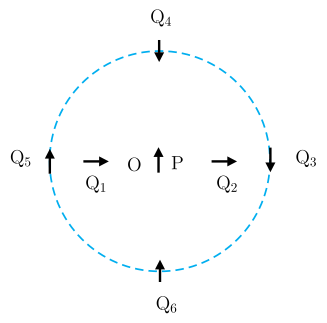
Q.Figure 5.4 shows a small magnetised needle P placed at a point O. The arrow shows the direction of its magnetic moment. The other arrows show different positions (and orientations of the magnetic moment) of another identical magnetised needle Q.
Figure 5.4
(a) In which configuration the system is not in equilibrium?
(b) In which configuration is the system in
(i) stable, and
(ii) unstable equilibrium?
(c) Which configuration corresponds to the lowest potential energy among all the configurations shown?
Imagine you have a bar magnet — the kind you might have stuck on your refrigerator. If you bring two of them close, something interesting happens. Sometimes they snap together with a satisfying click. Other times, they push each other away, refusing to touch no matter how hard you try.
That's not random. Every magnet has two special regions, one at each end, where the magnetic force is strongest. These are its magnetic poles.
Note
The word "pole" comes from the Greek polos, meaning "pivot" or "axis" — the Earth itself has a North Pole and a South Pole, and it behaves like a giant magnet.
The Two Types of Poles
Every magnet has exactly two poles: a north pole and a south pole. You cannot have a magnet with only one pole — cut a bar magnet in half, and each half immediately becomes a complete magnet with its own north and south poles.
The rule of interaction is simple and memorable:
Unlike poles attract: north pulls south, south pulls north.
Like poles repel: north pushes north away; south pushes south away.
This is the fundamental behaviour. No exceptions.
The Precise Statement
Magnetic poles are the regions of a magnet where the external magnetic field is strongest. Every magnet has exactly two poles — a north pole and a south pole — that cannot be isolated. Like poles repel; unlike poles attract.
The key points to remember for exams:
Poles always come in pairs — there is no magnetic monopole (a single isolated pole) in nature, despite decades of searching.
The north pole is defined as the pole that points toward Earth's geographic north when the magnet is freely suspended.
The south pole points toward Earth's geographic south.
A Common Confusion (Watch Out)
Watch out
Earth's geographic North Pole is actually a magnetic south pole. Why? Because the north pole of a compass needle (which is a magnetic north pole) is attracted to it. And unlike poles attract. So the Earth's north pole behaves like a magnetic south pole. This often trips students up in exams.
Why This Matters …
Why this formula?
Magnetic Poles: Why the Key Formulas Hold
Let's build this from first principles — understanding why a magnetic pole behaves the way it does, not just memorizing the result.
1. What Is a Magnetic Pole?
A magnetic pole is a conceptual point where the magnetic field appears to originate or terminate. In reality, magnetic poles always come in north-south pairs (no isolated monopoles exist in nature), but we treat them as idealized sources for calculations.
North pole: source of magnetic field lines (outward)
South pole: sink of magnetic field lines (inward)
2. The Key Formula: Force Between Two Magnetic Poles
The force between two magnetic poles of strengths m1 and m2, separated by distance r, is:
F=4πμ0⋅r2m1m2
Why this form?
This is a Coulomb's law analog — and that's not a coincidence. Here's the reasoning:
Experimental observation: Magnetic poles attract/repel with a force that:
Varies as 1/r2 (inverse square law)
Is proportional to the product of pole strengths
Depends on the medium (via μ0, the permeability of free space)
Mathematical analogy: The magnetic field B at distance r from a single pole m is:
B=4πμ0⋅r2m
This comes from Gauss's law for magnetism applied to a point source.
Force derivation: The force on pole m2 in the field of pole m1 is:
F=m2⋅B1=m2⋅(4πμ0⋅r2m1)
Hence:
F=4πμ0⋅r2m1m2
Key insight: The 1/r2 dependence is not arbitrary — it follows from the geometry of 3D space (flux spreads over a sphere of area 4πr2).
3. The Magnetic Field of a Bar Magnet (Two Poles)
For a bar magnet of length 2l with poles +m and −m, the field at a point on the axis at distance x from the center is:
B=4πμ0⋅(x2−l2)22ml
Why this form?
Superposition principle: The total field is the vector sum of fields from the north pole (+m) and south pole (−m).
Field from north pole at distance (x−l):
BN=4πμ0⋅(x−l)2m(away from north)
Field from south pole at distance (x+l):
BS=4πμ0⋅(x+l)2m(toward south)
Net field (both along same direction on axis):
B=BN−BS=4πμ0m[(x−l)21−(x+l)21]
Simplify using algebra:
(x−l)21−(x+l)21=(x2−l2)24xl
Therefore:
B=4πμ0⋅(x2−l2)24mxl
But for a bar magnet, the magnetic moment is M=m⋅(2l) (pole strength × separation). So 2ml=M, giving:
B=4πμ0⋅(x2−l2)22Mx
Key insight: The field is not simply 1/r2 because we have two poles — the net effect is a dipole field, which falls off as 1/r3 at large distances.
Needle Q sits in the dipole field BP of the central needle P, whose moment points up. Its orientation energy is U=−mQ⋅BP=−mBcosθ. Equilibrium (τ=mQ×BP=0) needs mQ parallel (stable, U minimum) or antiparallel (unstable, U maximum) to the local field.
On P's axis (Q4 top, Q6 bottom) the field points up (parallel to mP), magnitude Baxial=4πμ0r32m.
On P's equator (Q1, Q2, Q3, Q5) the field points down (antiparallel to mP), magnitude Beq=4πμ0r3m. …
P's moment points up, so its field is upward on the axis (at Q4, Q6) and downward on the equator (at Q1, Q2, Q3, Q5). A needle is in equilibrium only when its moment is parallel (stable) or antiparallel (unstable) to the local field. (a) Q1 and Q2 are not in equilibrium. (b) Stable: Q3 and Q6; unstable: Q4 and Q5. (c) Q6 has the lowest potential energy.
Concept Understanding
Each needle is a magnetic dipole. Needle Q sits in the field BP of the central needle P, whose moment points up. The orientation energy is U=−mQ⋅BP=−mBcosθ, where θ is the angle between mQ and the local field.
On P's axis (top point Q4, bottom point Q6) the dipole field is parallel to mP (points up), with magnitude Baxial=4πμ0r32m.
On P's equator (Q1, Q2 near O, and Q3, Q5 on the circle) the field is antiparallel to mP (points down), with magnitude Beq=4πμ0r3m.
Zero torque (τ=mQ×BP=0) requires mQ parallel or antiparallel to the local field. Parallel (θ=0) is a potential-energy minimum, so stable; antiparallel (θ=180∘) is a maximum, so unstable.
Method: Equilibrium of a Dipole in Another Dipole's Field
This method applies to any problem where several small magnetic (or electric) dipoles are placed at different points around a central dipole, and you must classify each one's equilibrium state.
Steps
Step 1: Identify the field pattern of the source dipole
A dipole's field has two characteristic symmetry zones you should recognise on sight:
On the axial line (extension of the dipole axis): field is parallel to the dipole moment, magnitude
Baxial=4πμ0r32m
On the equatorial line (perpendicular bisector through the centre): field is antiparallel to the dipole moment, magnitude
Beq=4πμ0r3m
For any other angular position, use the general dipole field expression instead of assuming one of these two special cases.
Step 2: Write the equilibrium condition
A dipole placed in a field B feels torque τ=m×B. Equilibrium (τ=0) requires m to be parallel or antiparallel to the local field at that point — never to the source dipole's own moment direction, and never to some average or global direction.
Step 3: Classify stable vs unstable using potential energy