Q.A straight wire carrying a current of is bent into a semi-circular arc of radius as shown in Fig. 4.11(a). Consider the magnetic field at the centre of the arc.
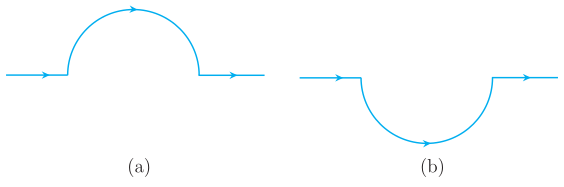
The magnetic field at the centre of a current-carrying semicircular arc comes only from the curved part -- the straight segments contribute zero field because their lines of action pass through the centre. The semicircle gives half the field of a full circular loop, and flipping the arc simply reverses the field direction.
Why the Biot–Savart Law?
The Biot–Savart law tells us that a current element produces a magnetic field at a point given by
where points from the element to the observation point. The key geometric insight: if the current element lies along the line joining it to the observation point, the cross product is zero -- that element contributes nothing.
For the centre of a circular arc, every straight segment that points radially toward or away from the centre has parallel (or antiparallel) to , so its contribution vanishes. Only the curved part, where is perpendicular to , produces a field.
-
Straight segments: zero contribution
In Fig. 4.11(a), the wire enters horizontally from the left, bends into a semicircle bulging upward, then continues horizontally to the right. At the centre of the semicircle, both straight segments lie along radii -- the left segment points directly toward the centre, the right segment points directly away from it. For any element on these straight parts, is exactly along (or opposite), so . Hence the magnetic field from the straight segments is zero.
Watch outA common mistake is to think the straight segments contribute like infinite wires. But the Biot–Savart law cares about the direction from element to point, not the overall wire shape. Here the centre lies exactly on the line of the straight segments -- the field from those segments is identically zero.
-
Semicircle vs. full circular loop
For a full circular loop of radius carrying current , the field at the centre is
directed perpendicular to the plane of the loop (right-hand rule).
For a semicircular arc, every current element on the curved part is perpendicular to (since points radially inward to the centre), and the magnitude of is just . Integrating over the semicircle (half the circumference, ) gives
This is exactly half the field of a full circular loop. The direction is the same as for the full loop -- perpendicular to the plane of the arc, following the right-hand rule.
Resemblance: Both produce a field perpendicular to the plane of the current, with magnitude proportional to .
Difference: The semicircle gives exactly half the magnitude because only half the current elements contribute.
-
Flipping the arc -- Fig. 4.11(b)
In Fig. 4.11(b), the wire is bent so the semicircle bulges downward instead of upward. The straight segments still lie along radii through the centre, so their contribution remains zero. The curved part still has the same radius and carries the same current -- the integration is identical. The magnitude of is unchanged: .
What changes is the direction. Using the right-hand rule: for the upward bulge (a), current flows left-to-right along the arc, and the field points into the page. For the downward bulge (b), the current direction along the arc is reversed relative to the centre, so the field points out of the page. The magnitude is the same; only the sign flips.
TipThink of the semicircle as half a loop. Flipping the arc is like flipping the loop over -- the field reverses direction but keeps the same strength.
- The magnetic field due to the straight segments is zero.
- The semicircle gives half the field of a full circular loop (), with the same perpendicular direction.
- Flipping the arc reverses the field direction but leaves the magnitude unchanged.
Unlock everything free for 14 days
- Full step-by-step solutions
- Concept-first explanations
- Methods, shortcuts & mistakes
- PYQ mapping + timed mock tests
Full access for 14 days. No credit card required.