Question of 46
Q.(a) What is the essential condition for diffraction of light to occur ?
(b) What is polarisation of light ? Explain polarisation of light by reflection with the suitable diagram and hence derive Brewster's law.
OR
(a) Why does the sky appear blue ?
(b) With the help of suitable diagram, sign conventions and assumptions, derive Lens Maker's formula for a convex lens.
Punjab PsebPSEB Punjab Class 12 Board 2018Subjective· 6mImportance★★★★★
0% · 0/46 Questions
You're viewing a preview — the full solution, concept, methods & PYQ mapping are locked.
Start your 14-day free trial to unlock the full solution →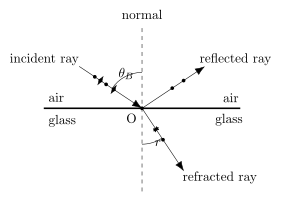
Diffraction requires an obstacle/slit of size comparable to the light's wavelength; light reflected at the Brewster angle is completely plane-polarised, and Brewster's law gives .
- Essential condition for diffraction: Noticeable diffraction of light occurs only when the size of the obstacle or aperture is of the same order of magnitude as the wavelength of the light used (roughly comparable to it) — since visible light wavelengths are only a few hundred nanometres, diffraction effects are prominent only with very narrow slits/small obstacles, which is why diffraction isn't obvious with everyday large-scale obstacles.
- Polarisation of light: Ordinary (unpolarised) light has its electric field vibrating in all directions perpendicular to the direction of propagation. Polarisation is the phenomenon of restricting these vibrations to just ONE plane containing the direction of propagation — such light is called plane- (linearly-) polarised light. This confirms that light is a TRANSVERSE wave (only transverse waves can be polarised). Polarisation by reflection and Brewster's law (derivation): When unpolarised light is incident on the boundary between two media (e.g. air-glass) at a particular angle of incidence called the polarising angle (or Brewster's angle) , the REFLECTED ray is found to be completely plane-polarised, with vibrations perpendicular to the plane of incidence — while the refracted ray remains only partially polarised. Brewster found experimentally (and it follows from the wave/dipole-radiation picture) that at this special angle, the reflected and refracted rays are perpendicular to each other: …
Unlock everything free for 14 days
- Full step-by-step solutions
- Concept-first explanations
- Methods, shortcuts & mistakes
- PYQ mapping + timed mock tests
Full access for 14 days. No credit card required.