Economics · Ch 15 — Environment and Sustainable Development
State Of India's Environment
State Of India's Environment
Drawn by us to help you understand the concept clearly, and verified to make sure it's accurate. For exams, practice from your textbook's own diagram.
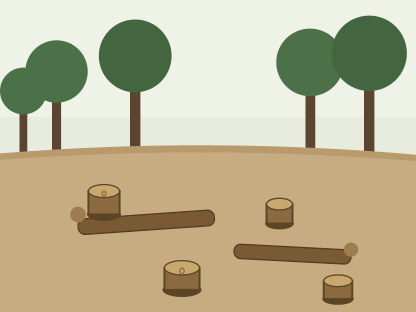
Own-drawn recreation of NCERT Fig 7.3 ( …
India is richly endowed by nature — fertile soils, hundreds of rivers and tributaries, dense forests, large mineral deposits, a long coastline on the Indian Ocean, and extensive mountain ranges. The black soil of the Deccan Plateau suits cotton cultivation and helped concentrate the textile industry there; the Indo-Gangetic plains, running from the Arabian Sea to the Bay of Bengal, form one of the world's most fertile, intensively farmed and densely settled regions. India's forests, though spread unevenly, give green cover to much of the population and shelter its wildlife, and the country holds large deposits of iron-ore, coal and natural gas — it accounts for close to 8 per cent of the world's iron-ore reserves — along with bauxite, copper, chromate, diamonds, gold, lead, lignite, manganese, zinc and uranium.
A double threat
Development has, however, pressed heavily on these finite resources while harming human health and well-being. India's environment faces a striking dichotomy: on one side, poverty-driven environmental degradation; on the other, pollution born of affluence and a fast-growing industrial sector. Air pollution, water contamination, soil erosion, deforestation and wildlife extinction are among the most pressing concerns. Five priority issues stand out: land degradation, biodiversity loss, air pollution (especially vehicular pollution in cities), management of fresh water, and solid-waste management.
Land degradation
Land across India suffers various kinds and degrees of degradation, largely from unstable use and poor management. The main factors behind it include: loss of vegetation through deforestation; unsustainable extraction of fuelwood and fodder; shifting cultivation; encroachment onto forest land; forest fires and overgrazing; failure to adopt adequate soil-conservation measures; improper crop rotation; indiscriminate use of fertilisers and pesticides; poor planning and management of irrigation; over-extraction of groundwater beyond the recharge capacity; open-access resources; and the poverty of people who depend on agriculture. Competing demands for land — forestry, farming, pasture, settlements and industry — put enormous pressure on the country's finite land.
The scale of the strain is stark. Per capita forest land is only about 0.06 hectare against a basic requirement of about 0.47 hectare, leading to excess felling of roughly 15 million cubic metres of forest beyond the permissible limit. Soil is being eroded at an estimated 5.3 billion tonnes a year, stripping away large quantities of nutrients — around 0.8 million tonnes of nitrogen, 1.8 million tonnes of phosphorus and 26.3 million tonnes of potassium annually. > [!THINK]
Work These Out
One student names a product used by an enterprise, and the other student is asked to trace out its roots to nature and earth -- for example: trucks ← steel and rubber; steel ← iron ← mineral ← earth; rubber ← trees ← forests ← earth; books ← paper ← trees ← forest ← earth; cloth ← cotton ← plant ← nature; petrol ← earth; machinery ← iron ← mineral ← earth.
A truck driver had to pay Rs 10,000 as a challan because his truck was emitting black soot. Why do you think he was penalised? Was it justified? Discuss.
India supports about 17 per cent of the world's people and 20 per cent of its livestock on merely 2.5 per cent of the world's land area, and this high density of humans and animals magnifies the pressure.
Chipko or Appiko — What's in a Name?
Drawn by us to help you understand the concept clearly, and verified to make sure it's accurate. For exams, practice from your textbook's own diagram.
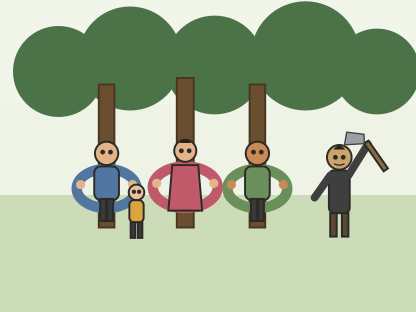
Own-drawn cartoon embedded inside Box 7.3 (p.121) in the real book, illustrating the box's own narrated Appiko incident -- own-art, not trace …
The Chipko movement in the Himalayas aimed to protect forests by having villagers embrace the trees so they could not be cut. In Karnataka a similar movement took the name Appiko, meaning 'to hug'. On 8 September 1983, when felling began in Salkani forest in Sirsi district, 160 men, women and children hugged the trees, forced the woodcutters away, and kept watch over the forest for weeks — leaving only after officials promised the trees would be cut scientifically and according to the district's working plan. That single act saved about 12,000 trees, and the movement quickly spread to neighbouring districts.
Such episodes illustrate the damage from indiscriminate felling for fuelwood and industry: bamboo was wiped out near a paper mill within twelve years, protective broad-leaved trees vanished, soil washed away leaving barren laterite, rivers dried up faster, rainfall turned erratic, and new crop diseases appeared. Appiko volunteers demanded rules such as consulting local people before marking trees and not felling trees within 100 metres of a water source or on slopes of 30 degrees or more.
The government allocates forest land to industries for raw material. Even if a paper mill employs 10,000 workers and a plywood factory employs 800 people, is it acceptable if doing so deprives the daily needs of a million people? What do you think?
Air pollution
Air pollution is worst in urban areas — where vehicles are the biggest contributors — and in a few zones crowded with industries and thermal power plants. Vehicular emissions are especially worrying because they are released at ground level and so have the greatest direct effect on people. The number of motor vehicles rose from about 3 lakh in 1951 to around 35 crore in 2022, with two-wheelers and cars making up roughly 85 per cent of registered vehicles and adding heavily to the pollution load. India is among the world's ten most industrialised nations, a status that has brought unplanned urbanisation, pollution and accident risk; the Central Pollution Control Board has identified seventeen categories of large and medium industries as significantly polluting.
Work This Out
Newspapers carry a column tracking the measure of air pollution. Cut out the news item a week before Diwali, on the day of Diwali, and two days after Diwali. Do you observe a significant difference in the value? Discuss in your class.
Pollution Control Boards
…