Economics · Ch 13 — Rural Development
Diversification Into Productive Activities
Diversification Into Productive Activities
Diversification is one of the central ideas of rural development. It means widening the base of rural livelihoods so that families do not depend on a single, risky source of income.
Diversification includes two aspects: one relates to a change in the cropping pattern — shifting the mix of crops a farmer grows rather than relying on just one or two — and the other relates to a shift of the workforce from agriculture towards allied activities (livestock, poultry, fisheries and the like) and towards the non-agriculture sector.
The need for diversification arises because there is greater risk in depending exclusively on farming for a livelihood. Diversifying into new areas reduces this risk and, at the same time, opens up productive and sustainable livelihood options for rural people. Much of the agricultural employment activity is concentrated in the Kharif season. But during the Rabi season, in areas with inadequate irrigation facilities, it becomes difficult to find gainful employment. Expansion into other sectors is therefore essential to provide supplementary gainful employment and to help rural people reach higher levels of income and overcome poverty and other hardships. Hence there is a need to focus on allied activities, non-farm employment and other emerging alternatives of livelihood, though many other options are also available for sustainable rural livelihoods.
As agriculture is already overcrowded, a major proportion of the growing labour force needs to find alternate employment opportunities in other non-farm sectors. The non-farm economy has several segments: some possess dynamic linkages that permit healthy growth — agro-processing industries, food-processing industries, the leather industry and tourism — while others are in subsistence, low-productivity propositions, such as traditional home-based industries like pottery, crafts and handlooms, which lack infrastructure and other support.
The majority of rural women find employment within agriculture while men generally look for non-farm employment; in recent times women too have begun looking for non-farm jobs (see Box 5.2).
Box 5.2: Tamil Nadu Women in Agriculture (TANWA)
Tamil Nadu Women in Agriculture (TANWA), a project initiated in the late 1980s in Tamil Nadu, trained women in the latest agricultural techniques and in organic farming, encouraging them to raise agricultural productivity and family income. At a Farm Women's Group in Thiruchirapalli, run by Anthoniammal, trained women successfully make and sell vermicompost and earn money from this venture. Many other Farm Women's Groups create savings in their group by functioning like mini banks through a micro-credit system, using the accumulated savings to promote small-scale household activities such as mushroom cultivation, soap manufacture and doll making.
Simple rural enterprises like jaggery making are further everyday examples of an allied activity that supplements farm income.
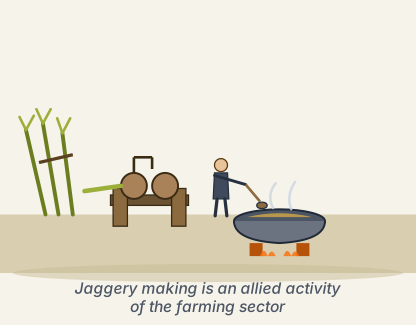
Drawn by us to help you understand the concept clearly, and verified to make sure it's accurate. For exams, practice from your textbook's own diagram.
Own-drawn recreation of NCERT Fig 5.2 (p.82) — a jaggery-making scene: a bullock/manual cane-crusher, sugarcane stalks, and a worker stirring a large pan of boiling cane juice over a fire …
The rest of this section looks at the concrete channels through which diversification takes place — animal husbandry, fisheries, horticulture and other alternate livelihood options.
Animal Husbandry: In India, the farming community follows a mixed crop-livestock farming system. Alongside their crops, families keep animals, of which cattle, goats and fowl (poultry) are the most widely held species. Livestock production provides greater stability in income, since animals earn even when crops do poorly, along with food security, nutrition, transport and fuel for the family, without disrupting other food-producing activities. Today the livestock sector alone provides alternate livelihood options to over 70 million small and marginal farmers, including landless labourers, and a significant number of women also find employment in it.
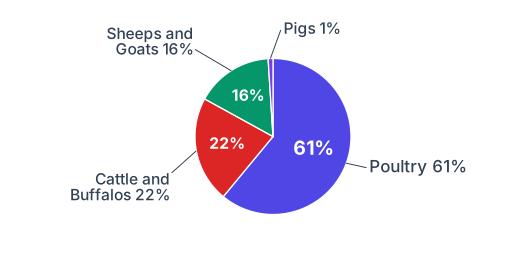
Chart 5.1 shows the distribution of poultry and livestock in India. Poultry accounts for the largest share, at about 61 per cent, followed by cattle and buffaloes (22 per cent), sheep and goats (16 per cent) and pigs (1 per cent).
Drawn by us to help you understand the concept clearly, and verified to make sure it's accurate. For exams, practice from your textbook's own diagram.
A pie chart showing India's poultry and livestock composition in 2019: Poultry 61%, Cattle and Buffalos 22%, Sheeps and Goats 16%, and Pigs 1%. Poultry is by far the largest category, reflecting how widely it is kept across rural househ …
Drawn by us to help you understand the concept clearly, and verified to make sure it's accurate. For exams, practice from your textbook's own diagram.
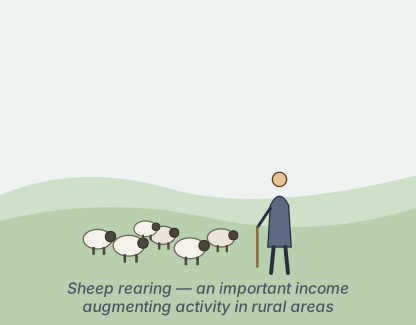
Own-drawn recreation of NCERT Fig 5.3 (p.84) — a shepherd with a flock of sheep on open, hilly grazing land. Own art, n …
At the lowest rung come animals such as camels, asses, horses, ponies and mules. In terms of large animals, India had about 303 million cattle in 2019, a figure that included around 110 million buffaloes.
The performance of the Indian dairy sector over the last three decades has been very impressive: milk production has increased by about ten times between 1951 and 2016. This is credited mainly to the successful implementation of Operation Flood, a system whereby all farmers pool the milk they produce, which is then graded according to quality, processed and marketed to urban centres through cooperatives. Under this system farmers are assured of a fair price and income from the supply of milk to urban markets. Gujarat is held up as a success story in the efficient implementation of milk cooperatives, a model emulated by many states; Gujarat, Madhya Pradesh, Uttar Pradesh, Andhra Pradesh, Maharashtra, Punjab and Rajasthan are the major milk-producing states. Meat, eggs, wool and other by-products are also emerging as important productive sectors for diversification.
Drawn by us to help you understand the concept clearly, and verified to make sure it's accurate. For exams, practice from your textbook's own diagram.
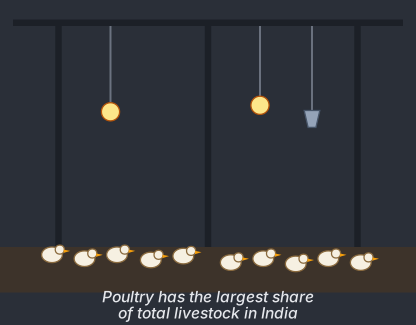
Own-drawn recreation of NCERT Fig 5.4 (p.85) — the interior of a poultry shed, reinforcing Chart 5.1's 61% poultry share. Own art, …
Though our livestock population is quite impressive in terms of numbers, its productivity is quite low as compared with other countries. Raising it requires improved technology, promotion of good breeds of animals, improved veterinary care, and adequate credit facilities for small and marginal farmers and landless labourers — this would enhance sustainable livelihood options through livestock production.
Fisheries: The fishing community regards the water body as a 'mother' or 'provider'. Seas, oceans, rivers, lakes, natural aquatic ponds and streams are, therefore, an integral and life-giving source for the fishing community. In India, after a progressive increase in budgetary allocations and the introduction of new technologies in fisheries and aquaculture, the development of fisheries has come a long way. Presently, fish production from inland sources contributes about 65 per cent of the total value of fish production, and the balance 35 per cent comes from the marine sector (sea and oceans). Total fish production now accounts for about 0.9 per cent of the total GDP. West Bengal, Andhra Pradesh, Kerala, Gujarat, Maharashtra and Tamil Nadu are the major fish-producing states.
A large share of fishworker families remain poor. The community faces rampant underemployment, low per-capita earnings, absence of mobility of labour to other sectors, and a high rate of illiteracy and indebtedness. Women are usually not involved in active fishing, but about 60 per cent of the workforce in export marketing and about 40 per cent in internal marketing of fish are women — which is why there is a need to increase credit facilities through cooperatives and Self-Help Groups for fisherwomen, to meet the working-capital requirements of marketing.
Production from fisheries has already increased substantially; however, problems related to over-fishing and pollution need to be regulated and controlled. Welfare programmes for the fishing community have to be reoriented in a manner that can provide long-term gains and the sustenance of livelihoods.
Horticulture: Blessed with varying climate and soil conditions, India has adopted the growing of diverse horticultural crops such as fruits, vegetables, tuber crops, flowers, medicinal and aromatic plants, spices and plantation crops. These crops play a vital role in providing food and nutrition, besides addressing employment concerns.
The horticulture sector contributes nearly one-third of the value of agricultural output and about six per cent of India's Gross Domestic Product. India has emerged as a world leader in producing a variety of fruits like mangoes, bananas, coconuts and cashew nuts and a number of spices, and is the second-largest producer of fruits and vegetables in the world. The economic condition of many farmers engaged in horticulture has improved, and it has become a means of improving livelihoods for many under-privileged classes.
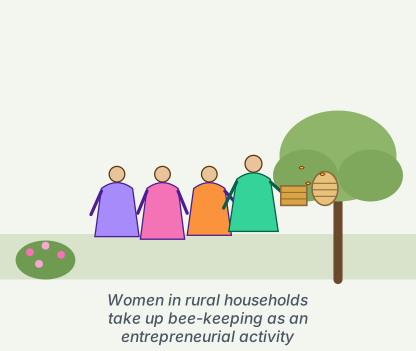
Flower harvesting, nursery maintenance, hybrid seed production and tissue culture, propagation of fruits and flowers, and food processing are highly remunerative employment options for women in rural areas. Related entrepreneurial activities such as bee-keeping are also taken up by women in rural households.
Drawn by us to help you understand the concept clearly, and verified to make sure it's accurate. For exams, practice from your textbook's own diagram.
Own-drawn recreation of NCERT Fig 5.5 (p.85) — four women under a tree, one holding an open beehive box, examining bees. Own art, …
Horticulture has emerged as a successful and sustainable livelihood option and needs to be encouraged significantly. Enhancing its role requires investment in infrastructure like electricity, cold storage systems, marketing linkages, small-scale processing units, and technology improvement and dissemination. …