Physical Education · Ch 6 — Test, Measurement & Evaluation
Classification of Tests in Physical Education and Sports
Classification of Tests in Physical Education and Sports
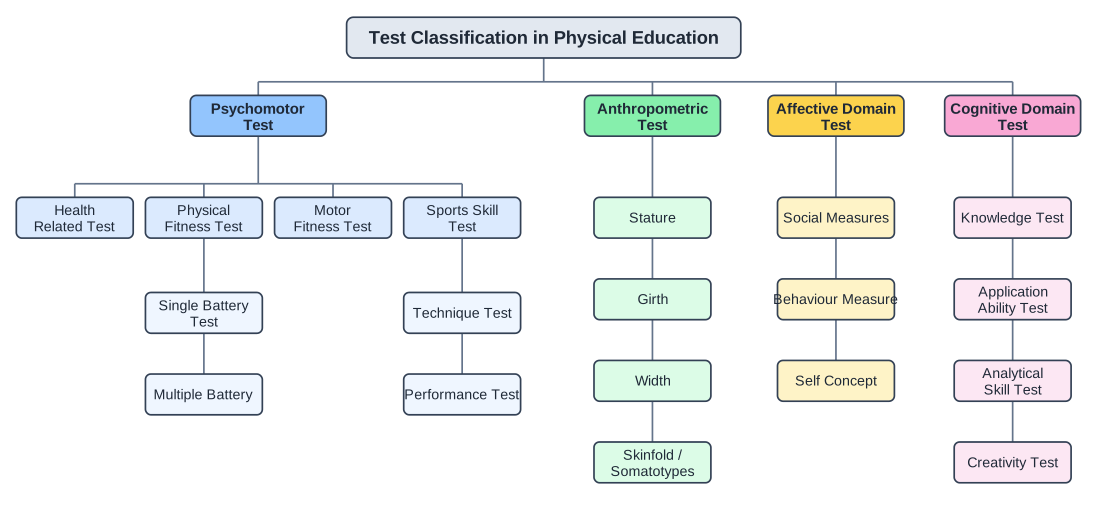
Because an athlete's performance depends on many kinds of traits, no single type of test is enough. Tests are classified by their nature and purpose into four broad categories, each assessing a different domain of the performer:
- Psychomotor Tests - movement and motor-response ability.
- Anthropometric Tests - the body's surface measurements and build.
- Affective-Domain Tests - feelings, emotions and social behaviour.
- Cognitive-Domain Tests - knowledge and mental ability.
Used together, these give a comprehensive picture of an athlete or participant. The full classification, with the sub-types under each category, is shown below.
Drawn by us to help you understand the concept clearly, and verified to make sure it's accurate. For exams, practice from your textbook's own diagram.
A top-down tree. The root 'Test Classification in Physical Education' branches to four classes. Psychomotor Test branches to Health Related Test; Physical Fitness Test (to Single Battery Test and Multiple Battery); Motor Fitness Test; and Sports Skill Test (to Technique Test and Performance Test). Anthropometric Test branches to Stature, Girth, Width and Skinfold/Somatotypes. Affective Domain Test branches to Social Measures, Behaviour Measure and Self Concept. Cognitive Domain Test branches …
As the tree shows, each class subdivides further - for example psychomotor tests into health-related, physical-fitness, motor-fitness and sports-skill tests, and anthropometric tests into stature, girth, width and skinfold/somatotype measures. Each of the four classes is explained in the subsections that follow.
Why classification matters
A single test score never tells the whole story about a performer. A sprinter might post an excellent 100 m time - a psychomotor/motor-fitness result - yet be carrying an anthropometric build poorly suited to repeated high-intensity sprinting, or may be so anxious before competition, an affective-domain factor, that the fast training time never shows up on race day. Classifying tests by the domain they probe stops a coach from over-relying on just one kind of number, and reminds them to check fitness, body build, mindset and knowledge together before drawing a conclusion about an athlete.
How the classification is applied in practice
When a coach or PE teacher plans a full assessment of a squad, the four-class system becomes a practical checklist rather than an abstract scheme:
- Run the relevant psychomotor tests for the sport's key fitness or skill demands, such as speed, endurance or a sport-skill test.
- Record the athlete's anthropometric profile - height, weight, BMI, girths - to check body suitability for the event.
- Use an affective-domain instrument where motivation, confidence or team cohesion is a concern.
- Check the athlete's tactical or rules-based cognitive understanding where game sense matters.
Taken together, the four readings let selectors and coaches make a rounded, defensible decision - for example, choosing a junior badminton player not only on footwork-speed scores but also confirming an appropriate build, a competitive temperament, and sound rules and tactical knowledge.