Q.Draw appropriate Venn diagram for each of the following :
You're viewing a preview — the full solution, concept, methods & PYQ mapping are locked.
Start your 14-day free trial to unlock the full solution →This problem asks you to draw Venn diagrams for the complements of unions and intersections of two sets. The key idea is that De Morgan’s laws link these four expressions: (A ∪ B)′ = A′ ∩ B′ and (A ∩ B)′ = A′ ∪ B′. So parts (i) and (ii) are equivalent, and parts (iii) and (iv) are equivalent. The final diagrams show the shaded regions accordingly.
The Concept: Set Difference and Complement
When we talk about the complement of a set, say A′, we mean everything outside A but inside the universal set U. Similarly, (A ∪ B)′ means everything outside the union of A and B — that is, elements that belong to neither A nor B.
The trick here is that De Morgan’s laws give us two pairs of identical expressions:
- (A ∪ B)′ = A′ ∩ B′
- (A ∩ B)′ = A′ ∪ B′
So you only need to understand how to shade one of each pair, and the other follows. Let’s draw them step by step.
Step-by-Step Drawing
We’ll use a standard Venn diagram with two overlapping circles (A and B) inside a rectangle (the universal set U). Shading will show the required region.
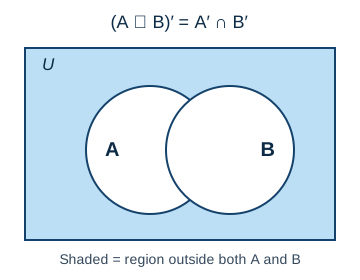
1. (i) (A ∪ B)′
First, think: A ∪ B is everything in A or B (or both). Its complement is everything not in A ∪ B — that is, the region outside both circles.
- Shade the part of U that lies outside both A and B.
- This is the area in the rectangle but not inside either circle.
2. (ii) A′ ∩ B′
Now, A′ is everything outside A, and B′ is everything outside B. Their intersection is the region that is outside A and outside B simultaneously.
- That’s exactly the same region as in (i): the area outside both circles.
- So the diagram for (ii) is identical to (i).
A common mistake is to think A′ ∩ B′ means “outside A and inside B” or something similar. Remember: intersection means both conditions must hold — so you need the region that is outside A and outside B at the same time. That’s the same as the complement of the union.
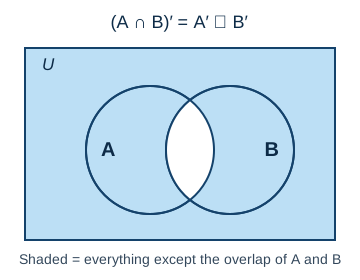
3. (iii) (A ∩ B)′
A ∩ B is the overlapping region (the “middle” part where A and B meet). Its complement is everything except that overlap.
- Shade all of U except the tiny lens-shaped region where A and B intersect.
- This includes: the part of A that is not in B, the part of B that is not in A, and the area outside both circles.
4. (iv) A′ ∪ B′
A′ is outside A, B′ is outside B. Their union is everything that is outside A or outside B (or both).
- That means: any point that is not inside A, or not inside B, or both. …
Unlock everything free for 14 days
- Full step-by-step solutions
- Concept-first explanations
- Methods, shortcuts & mistakes
- PYQ mapping + timed mock tests
Full access for 14 days. No credit card required.