Physics · Ch 13 — Oscillations
Periodic and Oscillatory Motions
Periodic and Oscillatory Motions
13.2 Periodic and Oscillatory Motions
Consider three everyday situations: an insect climbing up a ramp and falling back down, over and over; a child climbing a step and coming back down, again and again; and a ball bouncing between your palm and the floor. If you plot the height of each object above the ground against time, each graph has a different shape — the insect's graph looks different from the child's, and the bouncing ball's graph is made of parabolic arcs (each arc following for the downward part and for the upward part, with a different starting speed each bounce). Yet all three have one thing in common: the motion repeats itself identically after a fixed interval of time. This is the defining property of periodic motion — motion that repeats itself at regular intervals of time.
Equilibrium Position and the Origin of Oscillations
A body undergoing periodic motion very often has an equilibrium position somewhere along its path. At this position, no net external force acts on the body — if left there at rest, it stays there forever. But if the body is displaced slightly from the equilibrium position, a force comes into play that pushes it back toward that position. It is this restoring tendency that gives rise to oscillations (or vibrations). A simple example: a ball resting at the bottom of a bowl is in equilibrium there; nudge it a little, and it oscillates back and forth in the bowl before settling again.
Every oscillatory motion is periodic, but not every periodic motion is oscillatory. Circular motion is periodic — it repeats after one revolution — but it is not oscillatory, since the object never moves back and forth about a fixed point.
Oscillation vs. Vibration
There is no sharp physical distinction between the words "oscillation" and "vibration" — both describe the same kind of to-and-fro motion. In practice, the choice of word is mostly about frequency: a slow to-and-fro motion, like a tree branch swaying, is usually called an oscillation, while a rapid one, like a plucked guitar string, is usually called a vibration.
Simple Harmonic Motion — A Preview
The simplest kind of oscillatory motion is called simple harmonic motion (SHM). It occurs whenever the force acting on the oscillating body is directly proportional to its displacement from the mean position, and at every point in the motion this force is directed back toward that mean position (which, for SHM, coincides with the equilibrium position). The full mathematical treatment of SHM is developed later in this chapter.
Damping and Forced Oscillations …
Drawn by us to help you understand the concept clearly, and verified to make sure it's accurate. For exams, practice from your textbook's own diagram.
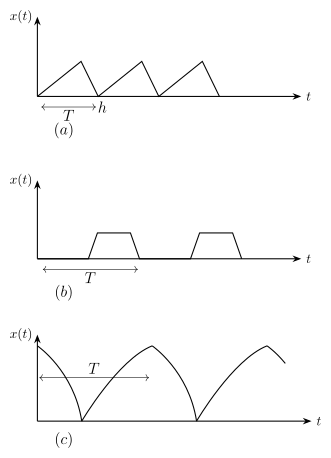
Fig. 13.1 in the NCERT textbook is a visual anchor for the very first idea of the chapter: what it means for a motion to be periodic. The figure stacks three separate graphs, each plotting some physical quantity against time . The horizontal axis in every panel is time, and the vertical axis is the value of — which could be displacement, voltage, or any quantity that repeats. The critical label shared by all three panels is the period , marked as the horizontal distance between successive identical features of the wave.
Panel (a) shows a triangular sawtooth waveform. The value of rises linearly from a minimum to a maximum, then drops sharply back to the minimum, and repeats exactly. The period is the time from one sharp drop to the next. This is a classic example of periodic motion that is not oscillatory — the motion does not swing back and forth about a central point; it simply ramps up and resets.
Panel (b) displays trapezoidal flat-topped pulses. Here rises, stays constant for a while, falls, stays at zero, and then repeats. The period is the time from the start of one pulse to the start of the next. This shape is common in digital signals and in mechanical systems where a force is applied for a fixed duration and then removed.
Panel (c) is the most physically intuitive: a train of parabolic bounce arcs with a small ball icon drawn on the curve. This represents the height of a bouncing ball as a function of time. Each arc is a parabola (because the ball's vertical motion under gravity is quadratic in time), and the ball hits the ground, bounces, and traces the next parabola. The period is the time between successive bounces — the time from one impact to the next. The ball icon makes it clear that this is a real physical object undergoing periodic motion.
The key distinction the figure teaches is that periodic motion simply means the motion repeats after a fixed time interval . It does not require the motion to be back-and-forth about an equilibrium point. The sawtooth and trapezoidal pulses are periodic but not oscillatory; only the bouncing ball, which does go up and down about the ground, is both periodic and oscillatory.
The central formula that the textbook develops from this figure is the definition of period itself:
where is the period (in seconds), and is the number of complete cycles observed in that total time. A cycle is one complete repetition of the motion — from any point on the waveform to the next identical point. For the sawtooth, one cycle is from one sharp drop to the next; for the trapezoidal pulse, from the start of one pulse to the start of the next; for the bouncing ball, from one impact to the next.
The figure also implicitly introduces the concept of frequency , defined as the number of cycles per unit time:
with units of hertz (Hz). If the period is 2 seconds, the frequency is 0.5 Hz — meaning half a cycle occurs each second. …