Q.Derive an expression for the velocity of a particle in simple harmonic motion and show its graph of variation with time.
🔒You're viewing a preview — the full solution, concept, methods & PYQ mapping are locked.
🔒 Start your 14-day free trial to unlock the full solution →Concept understanding — Simple Harmonic Motion
Simple Harmonic Motion: The Natural Rhythm of Things
Imagine a ball placed at the bottom of a perfectly smooth, U-shaped bowl. If you give it a gentle push, what happens? It rolls up one side, slows down, stops for an instant, then rolls back down, past the bottom, up the other side, stops, and returns. Left alone, it keeps doing this — back and forth, back and forth — in a steady, repeating rhythm.
That rhythm is the heart of Simple Harmonic Motion (SHM). It's the most fundamental kind of oscillatory (back-and-forth) motion in physics.
The Intuition: A Restoring Force That Fights Displacement
The key idea is this: the further you push the object from its resting (equilibrium) position, the stronger the force that tries to pull it back.
In the bowl, when the ball is at the bottom (equilibrium), gravity pulls straight down, and the bowl pushes straight up — no sideways force. But when you push the ball up the side, gravity now has a component that pulls it down the slope. The higher up the side you push it, the steeper the slope, and the stronger that pull-back force becomes.
This is a restoring force — it always points toward equilibrium. And crucially, in SHM, this restoring force is directly proportional to the displacement from equilibrium. Double the displacement, double the restoring force.
F=−kx
- F is the restoring force.
- x is the displacement from equilibrium.
- k is a positive constant (the "stiffness" of the system).
- The minus sign is crucial: it tells you the force is opposite to the displacement.
The Precise Statement
Simple Harmonic Motion is the motion of an object where the restoring force is directly proportional to the displacement from equilibrium and acts in the opposite direction.
That's it. That single condition — F=−kx — is the entire definition. Everything else (the sine waves, the formulas for period and frequency) follows mathematically from this one law.
What Does This Motion Look Like?
If you track the ball's position over time, you get a beautiful, smooth wave — a sine wave (or cosine wave). It's the same shape as the shadow of a spinning wheel cast on a wall.
The motion has three key descriptors:
- Amplitude (A): The maximum displacement from equilibrium. How far you initially pushed the ball up the side of the bowl.
- Period (T): The time it takes to complete one full back-and-forth cycle (e.g., from the leftmost point, back to the leftmost point).
- Frequency (f): How many cycles happen per second. f=1/T.
A remarkable fact: for a given system (fixed k and fixed mass m), the period and frequency do not depend on the amplitude. A big push and a tiny push take exactly the same time to complete one cycle. This is called isochronism — and it's why pendulums were used to keep time in clocks.
The Mathematical Description (Derived from F=−kx)
Using Newton's second law (F=ma) and the definition of acceleration (a=dt2d2x), the condition F=−kx becomes:
mdt2d2x=−kx
This is a differential equation. Its solution — the position as a function of time — is:
x(t)=Acos(ωt+ϕ)
Where:
- ω=mk is the angular frequency (radians per second). It tells you how fast the oscillation is.
- ϕ is the phase constant (determines where in the cycle you start measuring time). …
Starting from the SHM displacement equation and differentiating with respect to time gives the velocity, and re-expressing it in terms of displacement shows that velocity is maximum at the mean position and zero at the extremes, tracing out a cosine-shaped graph over time. …
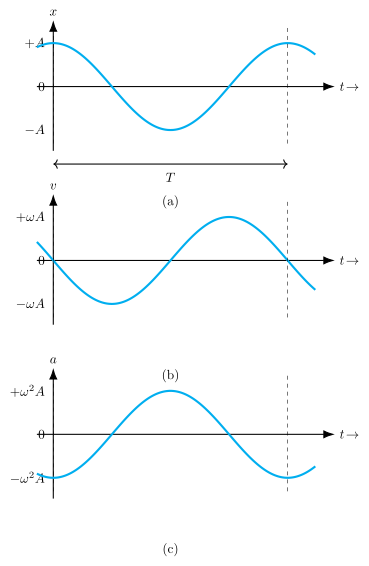
For x = A sin(ωt + φ), differentiating gives v = Aω cos(ωt + φ) = ω√(A^2 − x^2); v is maximum at the mean position and zero at the extremes, and its time graph is a cosine curve.
Let the displacement of a particle in SHM be:
x = A sin(ωt + φ)
where A is amplitude, ω is angular frequency, and φ is the initial phase. Velocity is the time derivative of displacement:
v = dx/dt = Aω cos(ωt + φ)
To express v in terms of x (rather than t), use sin^2 θ + cos^2 θ = 1. Since sin(ωt+φ) = x/A, we get cos(ωt+φ) = √(1 − x^2/A^2). So:
v = Aω √(1 − x^2/A^2) = ω√(A^2 − x^2)
Behaviour:
- At the mean position, x = 0: v = ω√(A^2 − 0) = Aω — this is the MAXIMUM speed (v_max = Aω).
- At the extreme positions, x = ±A: v = ω√(A^2 − A^2) = 0 — velocity is ZERO there (momentarily at rest before reversing). …
Showing the 12 most recent of 53 on this concept.
- CBSE 2026Set ANNUAL1 markMCQQ.In SHM, the restoring force is directly proportional to(a) Velocity(b) Displacement(c) Acceleration(d) Time
›Reveal solutionSolution
The defining equation of simple harmonic motion is F = -k x -- the restoring force is proportional to displacement x, with the negative sign showing it always acts to pull the object back toward equilibrium.
Simple Harmonic Motion (SHM) is defined precisely by this relationship between restoring force and displacement:
F = -k x
where x is the displacement from the mean/equilibrium position and k is a positive constant (the force constant). This means:
- The magnitude of the restoring force grows linearly with how far the object is displaced from equilibrium.
- The negative sign shows the force always points back toward the equilibrium position, opposing the displacement. …
- CBSE 2026Set ANNUAL1 markMCQQ.In SHM, the maximum velocity occurs at(a) The equilibrium position(b) Half of the amplitude(c) Maximum displacement from equilibrium(d) It is constant throughout the motion
›Reveal solutionSolution
Velocity in SHM is v(t) = -Aomegasin(omega t), which has its maximum magnitude (A*omega) exactly when displacement x = 0, i.e., at the equilibrium position.
For SHM with displacement x(t) = A cos(omega t), the velocity is:
v(t) = dx/dt = -A omega sin(omega t)
The magnitude of velocity is maximum when |sin(omega t)| = 1, which occurs precisely when cos(omega t) = 0, i.e., when x = 0 -- the equilibrium (mean) position.
…
- CBSE 2026Set ANNUAL1 markMCQQ.The restoring force in SHM is always(a) in the direction of motion(b) opposite to the direction of motion(c) independent of motion(d) zero
›Reveal solutionSolution
The restoring force F = -kx always points opposite to the displacement x (toward equilibrium), which is why it is described as always acting opposite to the object's motion away from the mean position -- this restoring tendency is what continually pulls the oscillator back and sustains the oscillation.
In SHM, F = -k x: whichever side of equilibrium the object is displaced to, the restoring force always points back toward the centre (equilibrium), i.e., in the direction opposite to the displacement vector. Practically, this means the restoring force is always directed so as to oppose (resist) the object's continued displacement away from the mean position -- described in this basic sense as "opposite to the direction of motion" away from equilibrium. (A more precise statement, taught alongside this idea, is that the restoring force is always opposite to displacement, not literally opposite to instantaneous velocity at every point of t …
- CBSE 2026Set ANNUAL1 markMCQQ.In simple harmonic motion, what is the phase difference between displacement and velocity?(a) 3π/4(b) π(c) π/2(d) 0
›Reveal solutionSolution
In simple harmonic motion, velocity is always π/2 (90°) out of phase with (ahead of) displacement.
For SHM, x(t) = A sin(ωt + φ). Differentiating, v(t) = dx/dt = Aω cos(ωt + φ) = Aω sin(ωt + φ + π/2). Comparing the arguments of the sine functions for x and v, velocity has an extra phase of +π/2 relative to displacement. Physically: when displacement is maximum (at the extreme position), velocity is zero; w …
- CBSE 2026Set ANNUAL1 markQ.Fill in the blank: Oscillatory motion is ________ only for small amplitude.
›Reveal solutionSolution
General oscillatory motion behaves as simple harmonic motion (SHM) only when the amplitude is small.
SHM requires a restoring force (or torque) that is exactly proportional to displacement from equilibrium, F = −kx. For many real oscillators — e.g. a simple pendulum, where the restoring torque involves sin θ — this proportionality is only approximate: sin θ ≈ θ holds accurately only for small angles θ (small amplitude). For larger amplitudes, the restoring force is no longer linear in the displacement; the motion is still periodic but is no longer strictly simple harmonic (the ti …
- CBSE 2026Set ANNUAL1 markQ.If the amplitude of a particle performing simple harmonic motion is doubled, then which quantity will become double?
›Reveal solutionSolution
Doubling the amplitude of an SHM particle doubles its maximum velocity and maximum acceleration (both are ∝ A); the total energy, however, becomes four times as large, since E ∝ A².
For a particle in SHM, x = A sin(ωt), v = Aω cos(ωt), a = −Aω² sin(ωt). The maximum values are x_max = A, v_max = Aω, and a_max = Aω². Since ω (angular frequency, set by the system's mass and restoring-force constant) does not depend on amplitude, both v_max and a_max are directly proportional to A — so if A is doubled, v_max and a_max each double as well. It's important to distinguish this from the total mechanical energ …
- CBSE 2026Set ANNUAL1 markMCQQ.The position of the body is given by x = A sin ωt. The time at which the displacement would be maximum is:(a) π/ω(b) π/2ω(c) πω(d) None of the above
›Reveal solutionSolution
x=Asinωt reaches its peak value A when the sine term equals 1, i.e. at t=π/2ω.
The position is x(t)=Asinωt. Since sinωt ranges only between −1 and +1, the displacement x is maximum (equal to A) exactly when sinωt=1.
…
- CBSE 2026Set ANNUAL1 markQ.Write true or false: Every oscillatory motion is periodic but every periodic motion is not oscillatory.
›Reveal solutionSolution
The statement is TRUE: 'oscillatory' is a stricter condition than 'periodic'.
A periodic motion is any motion that repeats itself identically after a fixed time interval (the period) — for example, uniform circular motion (a particle going round and round a circle at constant speed) is periodic, but it is not oscillatory because the particle never reverses direction and moves back and forth about a mean position; it just keeps circulating the same way.
…
- CBSE 2026Set ANNUAL1 markMCQQ.A particle executes simple harmonic motion with a time period of 6 second and amplitude of 3 cm. Its maximum speed in cm/sec will be(a) 3π(b) 2π(c) π(d) π/2
›Reveal solutionSolution
v_max = A omega = 3(2 pi/6) = pi cm/s. Answer (C).
In SHM the maximum speed is v_max = A omega, where omega = 2 pi/T.
Here A = 3 cm and T = 6 s, so:
…
- CBSE 2026Set ANNUAL1 markMCQQ.The displacement of a particle moving in simple harmonic motion (SHM) at any instant is given by y = a cosωt. The acceleration after time t = T/4 (where T is time period) is(a) 0(b) − aω^2(c) aω^2(d) − aω
›Reveal solutionSolution
At t = T/4 the displacement is zero (mean position), so acceleration = -omega^2 y = 0. Answer (A).
Given y = a cos(omega t). Acceleration in SHM is:
a(t) = d^2y/dt^2 = -a omega^2 cos(omega t) = -omega^2 y.
…
- CBSE 2026Set ANNUAL1 markMCQQ.A simple harmonic oscillator has an amplitude a and time period T. The time required by it to travel from x = a to x = a/2 is(a) T/2(b) T/4(c) T/3(d) T/6
›Reveal solutionSolution
Starting from the extreme (x = a), x = a/2 is reached at t = T/6. Answer (D).
Start timing from the extreme position, so x = a cos(omega t) (at t = 0, x = a).
When x = a/2: …
- CBSE 2025Set ANNUAL1 markMCQQ.In simple harmonic motion, the phase difference between acceleration and displacement is (A) 0° (B) π (C) π/2 (D) 2π
›Reveal solutionSolution
Acceleration and displacement in SHM are 180° (π radian) out of phase.
For a particle in SHM, displacement is x=Asin(ωt) and acceleration is:
a=−ω2x=−ω2Asin(ωt)=ω2Asin(ωt+π)
…
🎓Unlock everything free for 14 days
- ✓Full step-by-step solutions
- ✓Concept-first explanations
- ✓Methods, shortcuts & mistakes
- ✓PYQ mapping + timed mock tests
Full access for 14 days. No credit card required.