Q.A bob of mass is suspended by a light string of length . It is imparted a horizontal velocity at the lowest point A such that it completes a semi-circular trajectory in the vertical plane with the string becoming slack only on reaching the topmost point, C. Obtain an expression for
You're viewing a preview — the full solution, concept, methods & PYQ mapping are locked.
Start your 14-day free trial to unlock the full solution →This problem combines conservation of mechanical energy with the condition for circular motion. We find the initial velocity , the speeds at points B and C are and respectively, and the ratio of kinetic energies . After point C, the bob undergoes projectile motion.
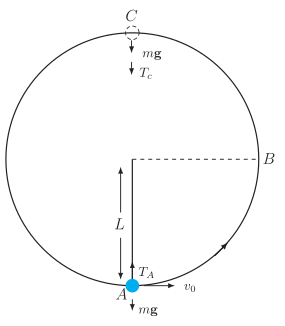
The figure shows a bob of mass attached to a light, inextensible string of length , swinging in a vertical circle. The string is fixed at the centre of the circle. The diagram captures three key positions: the lowest point A, an intermediate point B, and the highest point C.
At the bottom (point A), the bob is moving horizontally to the right with speed . The forces acting on it are drawn: tension pulls upward along the string, and weight pulls straight down. The net upward force provides the centripetal acceleration needed to keep the bob moving in a circle. A dashed horizontal line from the centre to the right marks the radius at the level of point B, which is at the same height as the centre.
At the top (point C), the bob is shown as a dashed circle — indicating it may or may not reach this point depending on the initial speed. Here both the tension and the weight point downward, toward the centre of the circle. The string is still taut, but the tension could be very small or even zero at the critical case. An arrowhead on the circular path shows the direction of motion.
The physical idea the figure teaches is that in vertical circular motion, the bob’s speed changes continuously because gravity does work on it. At the bottom, the bob has maximum kinetic energy and minimum potential energy. As it rises, kinetic energy converts to gravitational potential energy, so the speed decreases. At the top, the bob has minimum kinetic energy and maximum potential energy. The tension in the string also varies — it is largest at the bottom and smallest at the top.
The textbook uses this figure to apply conservation of mechanical energy between the bottom and the top. Taking the bottom as the reference level for potential energy (), the total mechanical energy at A is
At the top (point C), the bob is at height above the bottom, so its potential energy is . If its speed there is , then
Since only gravity does work (the string tension is always perpendicular to the motion and does no work), mechanical energy is conserved:
This gives the relation between the speed at the bottom and the speed at the top:
Here is the speed at the lowest point, is the speed at the highest point, is the acceleration due to gravity, and is the radius of the circle (the string length).
The figure also sets up the condition for the bob to just complete the circle. At the top, the minimum possible speed occurs when the tension becomes zero — the weight alone provides the centripetal force:
Substituting this into the energy equation gives the minimum initial speed required at the bottom:
A common mistake is to think the bob’s speed is constant in vertical circular motion. It is not — only the magnitude of the velocity changes because gravity does work. The string tension does no work, but it changes direction and magnitude to keep the bob on the circular path.
The diagram thus visually anchors two core ideas: energy conservation links the speeds at different heights, and the tension at the top can vanish, setting a critical condition for the motion to remain circular.
This problem is a classic application of two fundamental principles in mechanics: the conservation of mechanical energy and Newton's second law for circular motion. The key insight is understanding the condition for the string to become slack exactly at the topmost point.
When a bob is moving in a vertical circle, its speed changes due to gravity. Consequently, the tension in the string also changes. For the bob to complete a semi-circular trajectory and reach the topmost point C with the string becoming slack, it means that at point C, the tension in the string must be zero. If the tension were to become zero before C, the bob would leave the circular path earlier. If it were non-zero at C, it would continue in a full circle (or beyond C with tension).
Let's define our reference points:
- Point A: The lowest point, where the bob is imparted velocity . We'll set its potential energy .
- Point B: A point at the same horizontal level as the center of the circle. Its height above A is .
- Point C: The topmost point of the semi-circular trajectory. Its height above A is .
We will use the conservation of mechanical energy () between these points, and apply Newton's second law at point C to find the critical speed.
- Determine the speed at point C () using the condition for slack string. At the topmost point C, the string becomes slack, meaning the tension . The forces acting on the bob are its weight acting downwards. For the bob to follow a circular path, there must be a net centripetal force directed towards the center of the circle. At C, both the weight and the (zero) tension act downwards, towards the center of the circle. Applying Newton's second law in the radial direction at C:
Since $T_C = 0$:
Solving for $v_C$:
This is the minimum speed required at the top for the bob to just complete the semi-circle.
2. (i) Obtain an expression for .
We use the principle of conservation of mechanical energy between the lowest point A and the topmost point C. …
Unlock everything free for 14 days
- Full step-by-step solutions
- Concept-first explanations
- Methods, shortcuts & mistakes
- PYQ mapping + timed mock tests
Full access for 14 days. No credit card required.