Q.Consider Example 5.8 taking the coefficient of friction, , to be and calculate the maximum compression of the spring.
You're viewing a preview — the full solution, concept, methods & PYQ mapping are locked.
Start your 14-day free trial to unlock the full solution →Using the data from the previous spring-collision example (, , spring constant , on a horizontal road) with friction added, energy conservation with friction's work gives a maximum spring compression of .
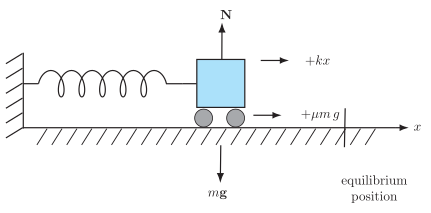
Recovering the referenced example's data
This question asks us to redo the previous spring-collision example with friction added, so we must first pin down what that example gives: a car of mass moving at speed on a horizontal, smooth road, colliding with a spring of spring constant . As a sanity check, the frictionless answer to that example is
which matches the previous example's result — confirming these are the correct values to carry forward.
Setting up the energy equation with friction
Now the road has friction, with coefficient . As the car slides forward and compresses the spring, two things remove its kinetic energy: the spring (which stores it as elastic potential energy) and friction (which removes it permanently as heat). At the point of maximum compression , the car is momentarily at rest, so all its initial kinetic energy has gone into these two channels:
The left side is the car's initial kinetic energy. The right side is the elastic potential energy stored in the spring plus the energy dissipated by friction over the distance that the car travels while compressing the spring.
A common mistake is to forget that friction acts over the entire compression distance , not just up to the point the spring is first touched. As long as the car keeps moving into the spring, friction keeps doing negative work on it.
Step-by-step solution
1. Write down the known quantities
2. Substitute into the energy equation
3. Rearrange into standard quadratic form …
Unlock everything free for 14 days
- Full step-by-step solutions
- Concept-first explanations
- Methods, shortcuts & mistakes
- PYQ mapping + timed mock tests
Full access for 14 days. No credit card required.