Question of 65
Q.(i) In which plants Hatch-Slack cycle takes place?
(ii) Explain mechanism of C4 cycle.
(iii) Draw a line diagram of C4 cycle.
OR
(i) What is ammonification?
(ii) Explain nitrification and dentrification.
(iii) Draw a line diagram of nitrogen cycle.
Rajasthan RbseRajasthan Board Senior Secondary Examination 2020Subjective· 4mImportance★★★★★est
0% · 0/65 Questions
You're viewing a preview — the full solution, concept, methods & PYQ mapping are locked.
Start your 14-day free trial to unlock the full solution →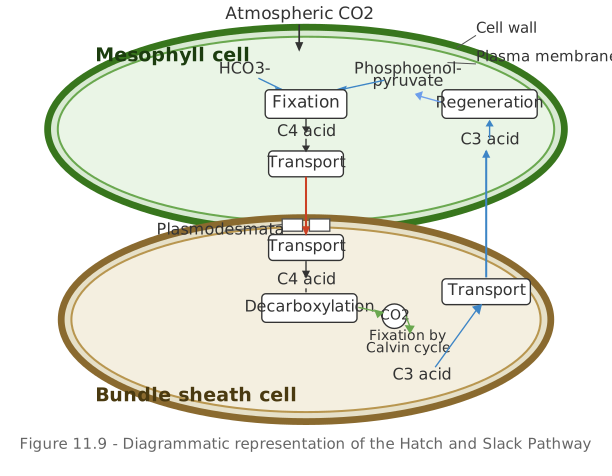
C4 plants use a two-cell-type (Kranz anatomy) CO2-concentrating shuttle — the Hatch-Slack pathway — to boost photosynthetic efficiency in hot, high-light environments.
- Plants showing the Hatch-Slack (C4) cycle: Tropical grasses and crops such as maize (corn), sugarcane, sorghum, and Amaranthus — plants adapted to high light intensity, high temperature and limited water, and possessing 'Kranz anatomy' (a wreath-like arrangement of bundle-sheath cells packed with chloroplasts, surrounding the vascular bundle, with mesophyll cells arranged radially around them).
- Mechanism of the C4 cycle:
- In mesophyll cells, atmospheric CO2 is fixed by the enzyme PEP carboxylase (PEPcase) onto phosphoenolpyruvate (PEP, a 3-carbon compound), forming oxaloacetic acid (OAA, a 4-carbon compound) — hence 'C4' pathway. PEPcase has a very high affinity for CO2 and no oxygenase activity, unlike RuBisCO.
- OAA is converted to malate (or aspartate), which is transported through plasmodesmata into the adjoining bundle-sheath cells.
- In the bundle-sheath cells, malate is decarboxylated, releasing CO2 and pyruvate. The released CO2 now enters the standard Calvin (C3) cycle in the bundle-sheath chloroplasts, being fixed by RuBisCO to build sugars — since bundle-sheath cells are relatively impermeable to gases, a high local CO2 concentration is maintained here, suppressing RuBisCO's wasteful oxygenase (photorespiration) activity. …
Unlock everything free for 14 days
- Full step-by-step solutions
- Concept-first explanations
- Methods, shortcuts & mistakes
- PYQ mapping + timed mock tests
Full access for 14 days. No credit card required.