Question of 117
Q.(i) Draw a labelled diagram of internal structure of human ear.
(ii) Explain the mechanism of hearing.
(iii) Write any two diseases/defects of ear.
OR
(i) Define reflex action.
(ii) Explain mechanism of reflex action.
(iii) Draw a line diagram of reflex action.
Rajasthan RbseRajasthan Board Senior Secondary Examination 2020Subjective· 4mImportance★★★★★est
0% · 0/117 Questions
You're viewing a preview — the full solution, concept, methods & PYQ mapping are locked.
Start your 14-day free trial to unlock the full solution →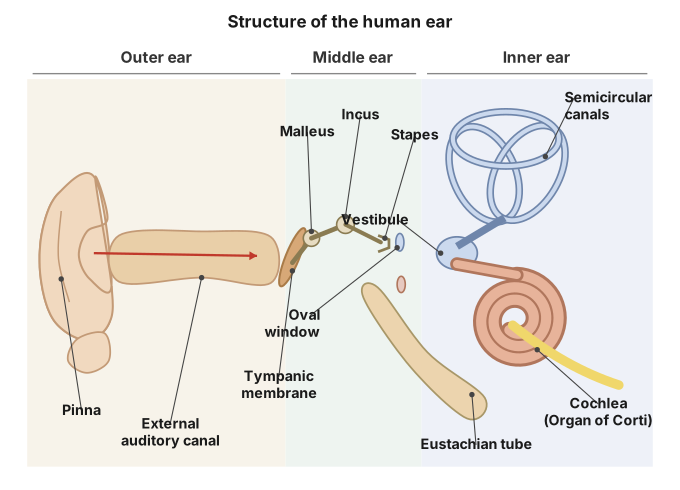
The ear converts sound waves into nerve impulses through outer, middle and inner sections, culminating in the cochlea's Organ of Corti.
(i) Structure (as would be shown in a labelled diagram), three regions:
- Outer ear: pinna (external flap that funnels sound) leading into the auditory canal (external auditory meatus), ending at the tympanic membrane (eardrum).
- Middle ear: an air-filled cavity containing three small bones (ossicles) — malleus (hammer), incus (anvil) and stapes (stirrup) — that connect the eardrum to the oval window of the inner ear; also connected to the throat via the Eustachian tube (pressure equalisation).
- Inner ear: a fluid-filled labyrinth containing the coiled cochlea (hearing) and the vestibular apparatus (semicircular canals + utricle/saccule, for balance). Inside the cochlea lies the Organ of Corti, the actual sound receptor, with hair cells resting on the basilar membrane.
(ii) Mechanism of hearing:
- The pinna collects and funnels sound waves down the auditory canal to the tympanic membrane, causing it to vibrate.
- These vibrations are transmitted and mechanically amplified through the chain of ossicles (malleus → incus → stapes) to the oval window of the cochlea.
- Vibration of the oval window sets up pressure waves in the cochlear fluid (perilymph/endolymph), which travel along the basilar membrane.
- These waves bend the hair cells of the Organ of Corti resting on the basilar membrane; bending of the hair-cell stereocilia opens ion channels, generating a receptor potential. …
Unlock everything free for 14 days
- Full step-by-step solutions
- Concept-first explanations
- Methods, shortcuts & mistakes
- PYQ mapping + timed mock tests
Full access for 14 days. No credit card required.