Q.i) What is transcription?
[1+2+1=4] OR
You're viewing a preview — the full solution, concept, methods & PYQ mapping are locked.
Start your 14-day free trial to unlock the full solution →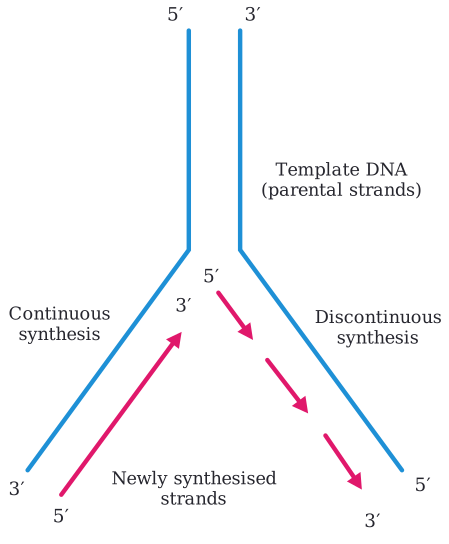
Transcription copies DNA into RNA; the lac operon is a classic inducible gene-control system switched on by lactose; and the replicating fork is the site where the DNA double helix unwinds and is copied into two daughter strands.
i) Transcription: Transcription is the process by which the genetic information encoded in a strand of DNA (the template strand) is copied into a complementary sequence of RNA, catalysed by the enzyme RNA polymerase.
ii) Structure and function of the Lac operon: The lac operon in E. coli consists of one regulatory gene (i, the repressor gene) and three structural genes (z, coding for beta-galactosidase; y, coding for permease; a, coding for transacetylase), all under the control of one shared promoter (p) and operator (o) region.
- In the absence of lactose (the inducer), the repressor protein (product of gene i) binds to the operator region and physically blocks RNA polymerase from transcribing the structural genes - the operon is OFF.
- When lactose is present, a metabolite of lactose (allolactose) binds to the repressor protein, changing its shape so it can no longer bind the operator. RNA polymerase is then free to transcribe the z, y, a genes, producing the enzymes needed to metabolise lactose - the operon is ON. This is why the lac operon is called an inducible operon.
iii) Replicating fork (labelled diagram, described): The replicating fork is the Y-shaped region formed when the two strands of the parental DNA double helix are unwound (by the enzyme helicase) during replication.
        Parental DNA (unwound by helicase)
              5'------------------3'   \
              3'------------------5'    \  <- Replication fork (Y-point)
                                          \
   Leading strand (continuous, 5'->3')  ----------->
   Lagging strand (discontinuous)        <---  <---  <---  (Okazaki fragments, joined by DNA ligase)
``` …
Unlock everything free for 14 days
- Full step-by-step solutions
- Concept-first explanations
- Methods, shortcuts & mistakes
- PYQ mapping + timed mock tests
Full access for 14 days. No credit card required.