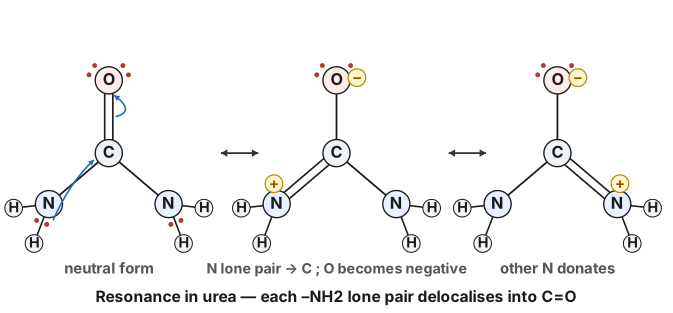
Q.A) Complete the following equations and identify A and B. R-C(=O)-NH2 --[Br2 + KOH]--> [A] --[CHCl3 + KOH]--> [B] B) Draw the resonating structures of Urea.
OR
A) Complete the following equations and identify A and B. C6H5NO2 --[Sn/HCl, 6H]--> [A] --[NaNO2 + HCl]--> [B] B) Draw the resonating structures of Aniline.
Imagine you have an amide — a molecule with a carbonyl group (−CO−) attached to a nitrogen. You want to turn it into a primary amine, but you also want to chop off one carbon from the chain. That is exactly what the Hofmann bromamide reaction does: it shortens the carbon skeleton by one carbon and gives you an amine.
The Intuition
The reaction uses bromine (BrX2) in the presence of a strong alkali (like NaOH or KOH). The alkali first deprotonates the amide nitrogen, making it a strong nucleophile. This nucleophile attacks bromine, forming an N-bromoamide. Under the strongly basic conditions, this intermediate loses a bromide ion and undergoes a rearrangement — the alkyl group attached to the carbonyl carbon migrates from carbon to nitrogen. The result is an isocyanate intermediate (R−N=C=O). Finally, the isocyanate is hydrolysed by the aqueous alkali to give a primary amine and carbon dioxide.
The net effect: the carbonyl carbon is lost as COX2, and the alkyl group ends up attached to the nitrogen.
Important
The product amine has one fewer carbon than the starting amide. The lost carbon is the carbonyl carbon.
The Precise Statement
Hofmann bromamide degradation (also called Hofmann rearrangement) is the conversion of a primary amide to a primary amine with one fewer carbon atom, using bromine and an aqueous alkali (usually NaOH or KOH).
Deprotonation: The amide nitrogen is deprotonated by the strong base, forming an amide anion.
R−CONHX2+OHX−R−CONHX−+HX2O
Bromination: The amide anion attacks bromine, forming an N-bromoamide.
R−CONHX−+BrX2R−CONHBr+BrX−
Second deprotonation: The N-bromoamide is deprotonated again by the base.
R−CONHBr+OHX−R−CONBrX−+HX2O
Rearrangement: The alkyl group migrates from the carbonyl carbon to the nitrogen, with simultaneous loss of bromide ion. This forms an isocyanate.
R−CONBrX−R−N=C=O+BrX−
Hydrolysis: The isocyanate reacts with water to form a carbamic acid, which spontaneously decarboxylates (loses COX2) to give the primary amine.
R−N=C=O+HX2OR−NH−COOHR−NHX2+COX2
Tip
The rearrangement step (step 4) is the key. The alkyl group migrates with its bonding electrons — it is a 1,2-shift from carbon to the electron-deficient nitrogen. This is why the carbon skeleton shortens by one carbon.
Key Points for Exams
Starting material: Primary amide (R−CONHX2) only. Secondary or tertiary amides do not undergo this reaction.
Reagents: BrX2 and NaOH (or KOH). Sometimes ClX2 can be used instead of BrX2, but bromine is more common.
Product: Primary amine with one fewer carbon.
By-products: NaBr, NaX2COX3, HX2O (or COX2 if written in the simplified form). …
The amide first loses its carbonyl carbon through Hofmann bromamide degradation to give a primary amine, which then reacts with chloroform and alcoholic KOH via the carbylamine reaction to form an isocyanide. …
Figure — Resonance (canonical) structures of urea H2N-CO-NH2. Draw the neutral form, then the charge-separate
R-CONH2 first loses one carbon via the Hofmann bromamide degradation to give the primary amine R-NH2 (=A), which then reacts with CHCl3/KOH (carbylamine test) to give the isocyanide R-NC (=B).
Step 1 (Hofmann bromamide degradation): R-C(=O)-NH2 (an amide) reacts with Br2 and KOH (alkali) to undergo the Hofmann degradation reaction. The amide loses its carbonyl carbon (as CO2, via an isocyanate intermediate R-N=C=O) and is converted to a primary amine having one carbon less than the starting amide:
Step 2 (Carbylamine reaction): the primary amine [A] (R-NH2) reacts with chloroform (CHCl3) and alcoholic KOH to give an alkyl isocyanide (carbylamine), which has a characteristic foul/offensive smell — this reaction is used as a chemical test to detect primary amines:
R-NH2 + CHCl3 + 3KOH → R-NC [B] + 3KCl + 3H2O
Resonating structures of Urea, H2N-CO-NH2: the lone pair of electrons on each -NH2 nitrogen is delocalised (conjugated) into the C=O π system, giving resonance structures such as: …
Same / Similar Concept — real previous-year questions on the same or a closely similar concept, not this exact question.
Showing the 12 most recent of 17 on this concept.
CBSE 2026Set A1 markMCQ
Q.By which of the following processes, is methyl amine prepared ?
(a) Wurtz reaction
(b) Hoffmann Bromamide reaction
(c) Friedel-Crafts reaction
(d) Kolbe's reaction
›Reveal solutionSolution
The Hoffmann bromamide degradation converts an amide to a primary amine with one fewer carbon; acetamide -> methylamine.
In the Hoffmann bromamide (degradation) reaction, an amide is treated with bromine and alkali (KOH), losing the carbonyl carbon and forming a primary amine with one carbon atom fewer:
Q.C6H5CONH2 + Br2 + 4NaOH -----> Product, Product is
(a) C6H5COOH
(b) C6H5NC
(c) C6H5NH2
(d) C6H6
›Reveal solutionSolution
Treating a primary amide with Br2 and excess NaOH is the Hofmann bromamide degradation, which shortens the carbon chain by one and gives a primary amine.
Q.Hofmann bromamide degradation reaction is shown by:
(a) CH3CH2NH2
(b) CH3CH2NO2
(c) CH3CONH2
(d) CH3CH2CN
›Reveal solutionSolution
The Hofmann bromamide degradation converts a primary AMIDE (RCONH2) into a primary amine with one carbon less, using Br2/KOH — only a compound with the amide (-CONH2) functional group can undergo it.
Q.Write the structure and IUPAC name of the amine produced by the Hofmann degradation of benzamide.
›Reveal solutionSolution
Hofmann degradation of benzamide (Br2/KOH) removes the carbonyl carbon as CO2 (via K2CO3) and converts the amide nitrogen directly into the ring's amino group, giving aniline.
The Hofmann bromamide degradation converts an amide, R−CONH2, into a primary amine, R−NH2, with the loss of one carbon atom (as carbonate), when treated with bromine in aqueous/alcoholic potassium hydroxide. Mechanistically it proceeds through an N-bromoamide, then a nitrene/isocyanate intermediate, and finally hydrolysis and decarboxylation of the resulting carbamic acid.
Q.Write True or False: Primary amines is prepared by Hoffmann bromamide reaction.
›Reveal solutionSolution
Hofmann bromamide degradation is indeed a standard method for preparing primary amines from amides.
In the Hofmann bromamide degradation reaction, an amide is treated with bromine and concentrated aqueous/ethanolic sodium hydroxide (or KOH). This converts the amide (RCONH2) into a primary amine (RNH2) with the loss of one carbon atom (as CO2, via an isocyanate intermediate):
Q.In Hofmann-bromamide reaction an amide is converted to :
(a) Primary amine
(b) Secondary amine
(c) Tertiary amine
(d) Aldehyde
›Reveal solutionSolution
The Hofmann bromamide reaction converts an amide into a primary amine with one carbon atom less than the starting amide.
When an amide (RCONH2) is treated with bromine in aqueous or ethanolic sodium hydroxide, it is converted to a primary amine (RNH2) containing one carbon atom less than the amide. This is called the Hofmann bromamide degradation reaction.
Q.Which of the following is formed when acetamide reacts with Br2/KOH?
(a) Acetone
(b) Methyl amine
(c) Acetaldehyde
(d) Ammonia
›Reveal solutionSolution
Hofmann bromamide degradation converts acetamide (CH3CONH2) to methylamine (CH3NH2), a primary amine with one fewer carbon.
An amide treated with bromine and aqueous KOH (or NaOH) undergoes the Hofmann bromamide (degradation) reaction, giving a primary amine that has one carbon fewer than the amide:
Q.What is Hoffmann's bromamide reaction? Give an example with a suitable chemical reaction. (½+½=1)
›Reveal solutionSolution
Hofmann's bromamide degradation converts an amide RCONH2 into a primary amine RNH2 having one fewer carbon atom, by treating it with bromine in concentrated aqueous/alcoholic sodium hydroxide.
Reaction (21 mark): When an amide is treated with bromine in the presence of concentrated NaOH solution, it degrades to give a primary amine containing one carbon atom less than the amide, along with the loss of the carbonyl carbon as carbonate:
R−CO−NH2+Br2+4NaOH→R−NH2+2NaBr+Na2CO3+2H2O
(Mechanistically, bromine first brominates the amide N-H to give an N-bromoamide, which loses HBr under base to form a nitrene/isocyanate intermediate that rearranges and hydrolyses, expelling CO2 (trapped as carbonate) to give the amine — this is why the product amine has one carbon less than the starting amide.)
Example (21 mark): Acetamide is converted to methylamine:
Q.Benzamide, C6H5CONH2 on reduction with LiAlH4 followed by hydrolysis gives an amine. It also undergoes Hofmann's bromamide reaction (with Br2 / KOH) and forms amine. What will be the difference between the two amines ?
›Reveal solutionSolution
The two routes give different amines: LiAlH₄ reduction keeps the carbon skeleton (benzylamine), while the Hofmann degradation strips out one carbon as CO₂ (aniline).
Route 1 — LiAlH4 reduction: Reduction of the amide carbonyl converts −CONH2 directly into −CH2NH2, without loss of any carbon:
Route 2 — Hofmann bromamide degradation: Treating the amide with Br2/KOH converts it to an isocyanate intermediate which hydrolyses with loss of the carbonyl carbon as CO2, giving an amine with one carbon less than the starting amide, and with the −NH2 attached directly to the ring:
Q.Write the reagent required (denoted '?') for the following reaction: CH3CONH2 --?--> CH3NH2.
›Reveal solutionSolution
Amides are converted to amines with one fewer carbon by the Hofmann bromamide degradation, using bromine in aqueous alkali.
Identifying the reaction: CH3CONH2 (acetamide, 2 carbons) converting to CH3NH2 (methylamine, 1 carbon) is a degradation that removes the carbonyl carbon — the Hofmann bromamide (Hofmann rearrangement) reaction.
Reagent and conditions: Bromine (Br2) in aqueous sodium hydroxide (NaOH).