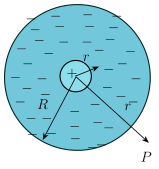
Q.An early model for an atom considered it to have a positively charged point nucleus of charge , surrounded by a uniform density of negative charge up to a radius . The atom as a whole is neutral. For this model, what is the electric field at a distance from the nucleus?
You're viewing a preview — the full solution, concept, methods & PYQ mapping are locked.
Start your 14-day free trial to unlock the full solution →We use Gauss's Law to find the electric field in two regions: inside and outside the negative charge cloud. The field is zero outside the atom, and inside, it is .
The problem describes an early atomic model with a point nucleus of charge at the center, surrounded by a uniformly distributed negative charge cloud up to a radius . The atom as a whole is neutral. We need to find the electric field at a distance from the nucleus.
This problem exhibits spherical symmetry. Whenever we have a spherically symmetric charge distribution, Gauss's Law is the most efficient tool to calculate the electric field. Gauss's Law states that the total electric flux through any closed surface (called a Gaussian surface) is proportional to the total electric charge enclosed within that surface.
Here, is the electric field, is an infinitesimal area vector on the Gaussian surface, is the total charge enclosed by the Gaussian surface, and is the permittivity of free space. Due to spherical symmetry, the electric field will be radial, pointing outwards for positive enclosed charge and inwards for negative enclosed charge. Its magnitude will be constant on any spherical surface centered at the nucleus. Thus, for a spherical Gaussian surface of radius , the integral simplifies to .
We need to consider two distinct regions:
- Outside the atom:
- Inside the negative charge cloud:
Let's proceed step-by-step.
- Determine the total negative charge and its volume charge density. The atom as a whole is neutral. Since the nucleus has a positive charge , the total negative charge distributed in the cloud must be . This negative charge is uniformly distributed within a sphere of radius . The volume of this sphere is . The uniform volume charge density of the negative charge cloud is:
- Calculate the electric field for (outside the atom). Consider a spherical Gaussian surface of radius such that . This surface encloses the entire atom. The total charge enclosed, , is the sum of the nucleus charge and the total negative charge cloud:
Applying Gauss's Law:
This result makes sense: a neutral atom, when viewed from a distance much larger than its size, appears as a point charge of zero magnitude, hence producing no external electric field.
3. Calculate the electric field for (inside the negative charge cloud).
Consider a spherical Gaussian surface of radius such that .
The charge enclosed, , by this Gaussian surface consists of two parts:
* The positive charge of the nucleus: .
* The negative charge enclosed within the Gaussian sphere of radius .
The volume of the Gaussian sphere is .
The negative charge enclosed, , is the product of the charge density and this volume:
Now, the total charge enclosed by the Gaussian surface is: …
Unlock everything free for 14 days
- Full step-by-step solutions
- Concept-first explanations
- Methods, shortcuts & mistakes
- PYQ mapping + timed mock tests
Full access for 14 days. No credit card required.